


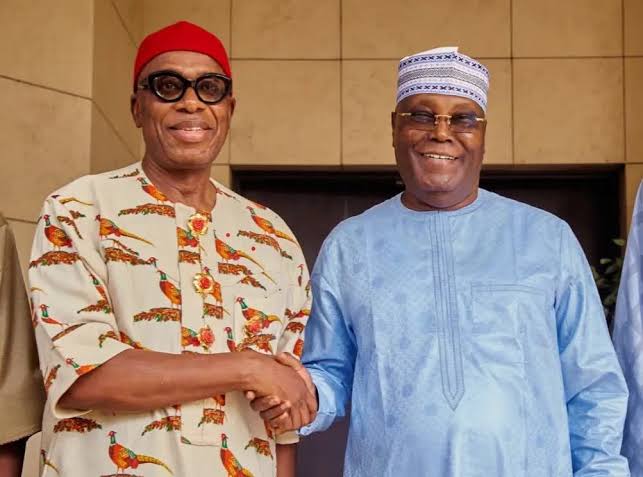
Nigeria’s opposition politics has entered one of its most dramatic and unpredictable phases as the African Democratic Congress, once considered a fringe political platform, suddenly finds itself at the center of national power calculations. What was initially presented as a broad coalition movement designed to challenge the ruling establishment has now transformed into a fierce internal confrontation between two of the most influential political gladiators in the country.
Former Minister of Transportation, Chibuike Rotimi Amaechi, has emerged as the dominant force shaking the foundation of the ADC with a highly coordinated presidential push that is rapidly altering the internal balance of power within the party. Standing directly in his path is former Vice President Atiku Abubakar, a veteran political heavyweight whose long standing presidential ambition now faces perhaps its most dangerous internal threat yet.
Across Abuja political circles, conversations are no longer centered on whether the ADC can become competitive nationally. The bigger conversation has shifted toward which political titan will eventually control the party structure, dominate the delegates, and emerge as the face of the opposition movement heading into the next presidential contest.
Inside the ADC headquarters, tension has reached extraordinary levels. Party stakeholders, governors, lawmakers, youth coordinators, and grassroots mobilizers are now openly aligning with one camp or the other. Meetings that were previously cordial have reportedly become battle zones filled with suspicion, lobbying, and strategic maneuvering.
Get TikTok SEO Cheat here
Political observers say the situation reflects a deeper struggle over the future direction of opposition politics in Nigeria. On one side stands Amaechi, projecting himself as a younger, aggressive reform minded politician capable of energizing frustrated voters. On the other side is Atiku, presenting himself as the experienced statesman with the national network and economic credentials needed to confront the ruling establishment.
What initially appeared to be a coalition of convenience is now evolving into a brutal contest for political survival.
The Sudden Rise of ADC as a Political Battlefield
The African Democratic Congress was not originally viewed as the primary battlefield for elite political competition. However, the dramatic realignments that reshaped opposition politics created an unexpected vacuum that instantly elevated the party into national relevance.
Following the departure of several influential figures toward alternative political arrangements, the ADC suddenly became attractive to ambitious politicians searching for a fresh platform with fewer structural restrictions.
Amaechi’s arrival fundamentally changed the equation.
Rather than quietly integrating into the party, the former Rivers governor reportedly entered with a carefully calculated strategy aimed at rapidly consolidating influence across multiple regions. Sources within the party indicate that his camp immediately began strengthening grassroots structures, recruiting coordinators, and opening communication channels with influential stakeholders in strategic states.
His emergence energized many younger party members who believe the opposition requires a more aggressive and energetic face capable of confronting the ruling establishment directly.
Atiku’s supporters, however, insist that political excitement cannot replace electoral experience.
They argue that the former Vice President remains the most nationally recognized opposition figure with tested structures across northern Nigeria and longstanding relationships with influential political stakeholders.
The result is a party now sharply divided between two competing visions.
Amaechi’s Strategy to Outmaneuver Atiku
Political insiders describe Amaechi’s campaign style as highly tactical, intense, and unapologetically confrontational.
Rather than merely competing for delegates, his camp is reportedly attempting to weaken Atiku’s traditional influence before the primary process even begins.
One of the strongest pillars of Amaechi’s campaign is his emphasis on generational transition. Supporters consistently frame him as a leader with executive energy, administrative experience, and infrastructure credentials capable of attracting younger voters frustrated with older political figures.
His transportation record has become central to this messaging strategy.
Campaign coordinators frequently point toward railway modernization projects and infrastructure expansion during his time as Minister of Transportation as evidence of practical governance experience.
Key Elements of Amaechi’s Campaign Strategy
| Strategy Area | Amaechi’s Approach |
|---|---|
| Youth Mobilization | Aggressive outreach toward younger voters |
| Regional Expansion | Penetrating northern delegate blocs |
| Messaging Style | Reform driven and confrontational |
| Political Branding | Project oriented leadership image |
| Delegate Targeting | Early grassroots engagement |
Beyond rhetoric, Amaechi’s camp is reportedly investing heavily in strategic alliances across the North Central and North East regions, areas traditionally considered favorable territory for Atiku.
Political analysts believe this move represents the heart of Amaechi’s broader strategy.
If he successfully fractures Atiku’s northern support base, the former Vice President could face severe difficulty maintaining dominance within the delegate structure.
Atiku’s Resistance and the Fight for Political Relevance
Despite the mounting pressure, Atiku’s camp remains defiant.
Senior allies of the former Vice President insist that no opposition politician currently possesses the nationwide structure, financial network, and political experience required to rival him inside the ADC.
Within northern political circles, Atiku still commands enormous respect due to decades of coalition building and relationship management.
His loyalists argue that presidential politics in Nigeria cannot be won purely through media momentum or emotional narratives. According to them, elections remain heavily dependent on deep political structures, elite negotiations, and established grassroots machinery.
Areas Where Atiku Still Holds Strength
| Political Advantage | Description |
|---|---|
| Northern Influence | Strong historical connections across northern states |
| Elite Relationships | Extensive political alliances built over decades |
| Campaign Experience | Multiple presidential contests and negotiations |
| Delegate Familiarity | Longstanding ties with influential party figures |
| Economic Messaging | Focus on national economic recovery |
Still, concerns are quietly growing within his camp.
Some stakeholders fear that the perception of Atiku as a perennial presidential contender may gradually weaken enthusiasm among undecided delegates seeking a fresh political direction.
Others worry that younger voters may increasingly gravitate toward candidates projecting stronger energy and reformist aggression.
The Explosive Delegate War
Behind closed doors, the real battle is unfolding through intense delegate negotiations.
Party insiders describe the atmosphere as one of relentless lobbying, strategic promises, and nonstop political calculations.
Several ADC stakeholders reportedly believe the coming primary could become one of the most financially demanding contests in recent opposition history.
Delegates are now viewed as the ultimate political currency.
Both camps are aggressively working to secure loyalty across strategic zones while simultaneously attempting to weaken rival structures.
Political observers say the contest has evolved beyond ideology.
It is now a raw test of influence, negotiation power, financial capacity, and political endurance.
Growing Fear of Internal Collapse
While the fierce rivalry has elevated the ADC’s visibility nationally, many party leaders fear the internal conflict could ultimately destroy the coalition before the general election cycle even intensifies.
The collapse of earlier consensus negotiations reportedly created deep frustration among stakeholders who initially hoped the opposition would unite behind a single formidable candidate.
Instead, the ADC now risks entering a prolonged internal war capable of creating permanent divisions.
There are growing concerns that whichever camp loses the primary may struggle to fully support the eventual winner.
Some analysts even warn that a bitter outcome could trigger fresh defections toward rival political platforms, severely weakening the opposition’s collective strength.
Meanwhile, political strategists within the ruling establishment are reportedly observing the unfolding crisis closely, recognizing that a divided opposition significantly improves the incumbent’s tactical advantage.
The Road Ahead
As consultations intensify nationwide, both Amaechi and Atiku are expected to expand their political engagements aggressively in the coming weeks.
Amaechi appears determined to present himself as the disruptive force capable of reshaping opposition politics through aggressive mobilization and strategic regional penetration.
Atiku, meanwhile, continues relying on experience, national networks, and longstanding political relationships to preserve his dominance within the ADC structure.
For now, the party remains deeply divided between two powerful ambitions.
What began as an opposition rescue movement has transformed into a dramatic struggle for supremacy, influence, and political survival.
Inside the ADC, only one reality matters now.
The battle has fully begun.
Read More On: