

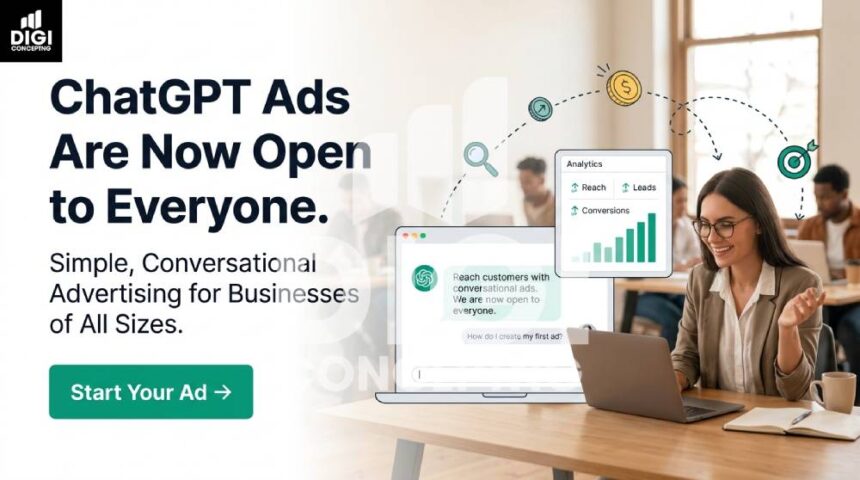
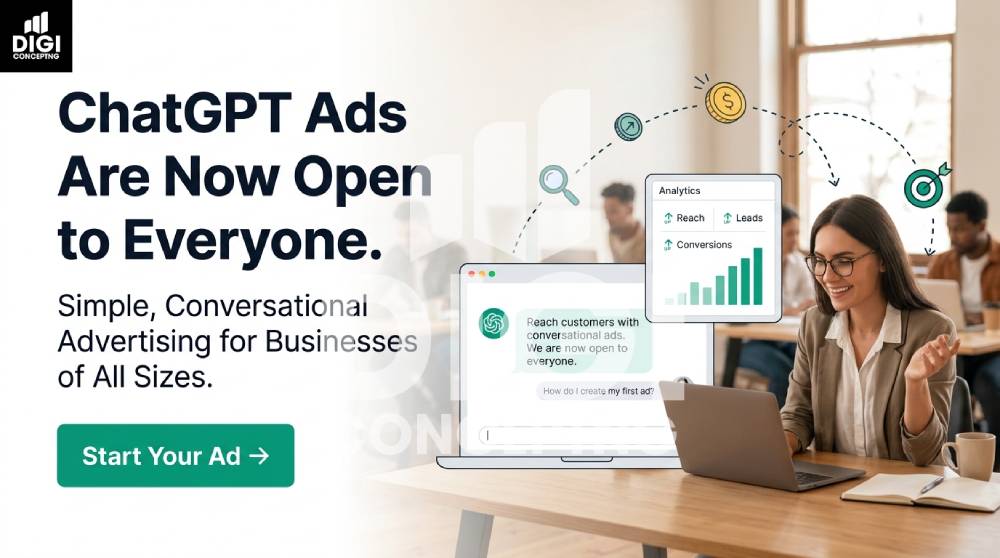
For a long time, ChatGPT was different from most of the internet. You could ask it a question, get an answer, write something, research an idea, or solve a problem without being interrupted by advertisements.
That is changing.

OpenAI has been gradually introducing advertising into ChatGPT, and by September 2026, ChatGPT advertising has moved well beyond its early testing stage. Advertisers can now reach ChatGPT users in a growing number of markets, while OpenAI continues to expand its advertising platform and self-service options.
But there is an important point to understand.
Get TikTok SEO Cheat here
When people say “ChatGPT Ads are now open to everyone,” it does not mean that every person in every country will suddenly see advertisements in ChatGPT. Availability depends on the country, account type and rollout. Free and Go users in eligible markets may see ads, while several paid and organizational plans remain ad-free.
For businesses and marketers, however, something much bigger is happening.
Advertising is moving into the AI conversation.
And that could change the way people discover businesses, products and services online.
What Are ChatGPT Ads?
ChatGPT Ads are advertisements displayed within the ChatGPT experience.
Instead of appearing on a traditional search results page, an advertisement can appear alongside a conversation after ChatGPT has responded to a user.
For example, imagine someone asks:
“What are the best running shoes for someone who exercises three times a week?”
ChatGPT may provide an answer explaining what to look for in a running shoe. An advertisement may then appear separately below the response.
The important difference is that the advertisement is clearly identified as sponsored content and is visually separated from ChatGPT’s answer.
So, the ad is not supposed to become part of the answer itself.
This is an important distinction because people are not using ChatGPT in exactly the same way they use Google, Facebook or Instagram.
They are having conversations.
That creates a completely different environment for advertising.
Are ChatGPT Ads Really Open to Everyone?
Not exactly, and this is where the headline can be misleading.
OpenAI has been expanding ChatGPT Ads into more countries and making its advertising tools available to more advertisers.
By the end of August 2026, OpenAI said its advertising business had reached a $1 billion annualized revenue run rate in less than 200 days, with tens of thousands of advertisers using the platform.
OpenAI also said ChatGPT Ads were available in more than 40 countries through its advertising solutions, agencies and technology partners, while self-service access through Ads Manager was expanding across markets including India, Europe, the Middle East and North Africa.
For users, advertising availability is still dependent on location and account type.
OpenAI says ads may appear for Free and Go users in eligible markets. Plus, Pro, Business, Enterprise and Edu plans do not currently have ads.
Accounts identified as belonging to people under 18 are also not shown ads.
So, the better way to describe the situation is this:
ChatGPT advertising is no longer a small experiment. It has become a serious global advertising business that is still expanding.
Why Is OpenAI Introducing Ads?
The obvious question is: why?
The answer is money, but there is more to it than that.
Running an AI service at the scale of ChatGPT is extremely expensive. Millions of people use the platform, and AI responses require significant computing power.
Advertising gives OpenAI another way to generate revenue while continuing to make AI available to a much larger number of people.
OpenAI has also said that advertising can help support broader access to ChatGPT.
In other words, the idea is not simply:
“Let’s put ads in ChatGPT.”
It is also:
“How can advertising help support a service that millions of people use without forcing everyone to pay for a subscription?”
That is a familiar model across the internet.
Google built a huge business around advertising while keeping its search engine free. Meta does something similar with Facebook and Instagram.
OpenAI is now entering that same economic conversation, but with a very different product.
What Makes ChatGPT Ads Different?
Traditional online advertising usually works around interruption.
You are reading an article and see an ad.
You are watching a video and an ad appears.
You scroll through Instagram and sponsored content appears.
You search Google and advertisements appear above or below the results.
ChatGPT is different because the user is already having a conversation.
Someone might say:
“I need a laptop for video editing. My budget is $1,500. What should I buy?”
That is not just a search query.
It is a detailed expression of intent.
The user has explained what they want, why they want it and what limitations they have.
That creates a potentially powerful advertising environment.
Instead of advertising simply based on someone’s broad interests, AI advertising can potentially exist much closer to the moment when a person is actually considering a decision.
That is one of the biggest reasons marketers are paying attention.
Welcome to Conversational Advertising
For years, digital advertising has been built around keywords, demographics, interests and browsing behaviour.
AI introduces another possibility: conversation.
Think about the difference.
A person searches:
“Best office chair.”
That tells an advertiser something.
But another person tells ChatGPT:
“I work from home for about eight hours every day. I have back discomfort and need a comfortable office chair under $400.”
The second person has provided much more context.
They have explained their situation, their problem and their budget.
That is extremely valuable information when someone is trying to understand customer intent.
This is why ChatGPT Ads could eventually become more than another place to display banners or sponsored links.
It could become a place where advertising happens around real questions and real buying decisions.
Can Advertisers Control ChatGPT’s Answers?
This is probably one of the biggest concerns users have.
If a company pays to advertise on ChatGPT, can it pay to make ChatGPT recommend its product?
According to OpenAI, no.
OpenAI says advertisers cannot shape, rank or alter ChatGPT’s answers.
The advertisement is separate from the response.
That distinction is important.
Imagine asking:
“Which phone is best for photography?”
If a phone company is advertising on ChatGPT, its advertisement should not automatically cause ChatGPT to say that its phone is the best.
The answer and the advertisement are separate parts of the experience.
Whether users will always perceive that separation clearly is another question, and this is something OpenAI will have to manage carefully as the advertising business grows.
Trust will be extremely important.
Can Advertisers See Your ChatGPT Conversations?
Another major concern is privacy.
People use ChatGPT for all kinds of things. Some conversations are casual, while others can contain personal, business or sensitive information.
OpenAI says advertisers do not receive access to users’ conversations, chat history, memories, names, email addresses, precise locations, IP addresses or sensitive personal information.
Advertisers instead receive aggregated, non-identifying performance information, such as how many people viewed or clicked an advertisement.
OpenAI can use some conversation context to determine which advertisements may be relevant to a user, but that information stays within ChatGPT and is not provided to advertisers as personal conversation data.
Users can also control certain advertising-related settings, including ad personalization.
That will become increasingly important as AI advertising develops.
How Are ChatGPT Ads Targeted?
This is where things get interesting.
Advertising has always depended on targeting.
Facebook uses interests and behaviour.
Google uses searches and other signals.
ChatGPT can potentially understand what someone is asking about right now.
For example, someone might ask:
“I’m travelling to Lagos next month. What should I pack for the weather?”
That conversation provides context.
Another person might ask:
“I’m opening a small restaurant. What equipment should I buy first?”
Again, the conversation provides context.
OpenAI says ad relevance can use things such as the current chat context, general location and language. When personalized ads are enabled, additional signals can include the current conversation, interactions with advertisements and certain information from previous chats or memory.
However, OpenAI says this information is not shared with advertisers as personal user data.
That distinction will matter greatly as people become more aware of how AI platforms use conversational information.
Who Can Advertise on ChatGPT?
The advertising platform is becoming increasingly accessible to businesses of different sizes.
It is not just about the world’s largest companies.
OpenAI has said that small businesses and startups are becoming a meaningful part of its advertising business.
The platform is also expanding beyond traditional CPM advertising.
OpenAI has introduced options involving CPC bidding and outcome-focused campaigns, alongside measurement tools such as the OpenAI Pixel and Conversions API.
For advertisers, that means ChatGPT Ads are becoming more like a proper performance advertising platform rather than simply an experimental advertising placement.
Businesses can increasingly think about questions such as:
- How much did I spend?
- How many people clicked?
- How many customers did the campaign generate?
- Which audience performed best?
- Did the traffic actually convert?
Those questions are familiar to anyone who has used Google Ads or Meta Ads.
What Does ChatGPT Ads Mean for Small Businesses?
ChatGPT Ads could give small businesses another way to reach customers without competing only on traditional advertising platforms.
The biggest opportunity is relevance. Instead of simply promoting a product, businesses can connect their advertising to the problems customers are already trying to solve.
For example, rather than:
“Affordable Business Software — Buy Now!”
a Nigerian software company could focus on:
“Simple accounting software for small Nigerian businesses.”
That speaks directly to a need.
For small businesses, the key will be understanding what customers ask, what problems they have and how their product can genuinely help.
What Does ChatGPT Ads Mean for Nigerian Businesses?
Nigerian businesses should pay attention because ChatGPT could become another channel through which customers discover products and services.
Someone might ask:
“What are reliable digital marketing agencies in Lagos?”
Or:
“Where can I get a professional website designed in Nigeria?”
Or:
“What accounting software is best for a small Nigerian business?”
These are not just searches. They show intent — the person is looking for a solution.
That could make ChatGPT particularly interesting for Nigerian service businesses, e-commerce companies and startups.
However, paying for an ad does not automatically make a business trustworthy or make ChatGPT recommend it.
A strong website, reputation, reviews, useful content and good customer experience will still matter.
The opportunity is simple: be visible when people are looking for a solution, but make sure you have something worth choosing when they find you.
ChatGPT Ads vs Google Ads vs Facebook Ads
ChatGPT Ads, Google Ads and Facebook Ads all help businesses reach potential customers, but they do it in very different ways.
Google is built around search intent, Facebook is built around social discovery and audience targeting, while ChatGPT is built around conversation and problem-solving.
| Feature | ChatGPT Ads | Google Ads | Facebook Ads |
|---|---|---|---|
| How users interact | Users have conversations and can ask follow-up questions | Users search for information, products or services | Users browse social content, videos, photos and posts |
| Main type of intent | Conversational intent — users explain what they need or want to solve | Search intent — users actively search for something | Interest and audience-based intent — users may discover something while browsing |
| Advertising environment | Ads appear separately from ChatGPT’s response | Ads can appear in search results and across Google’s advertising network | Ads appear within Facebook, Instagram and other Meta placements |
| Targeting approach | Can use relevant conversation context and other permitted signals | Keywords, audiences, location and other advertising signals | Demographics, interests, behaviours, audiences and other Meta signals |
| Customer journey | Question → conversation → consideration → possible action | Search → advertisement → website → action | Browse → discover ad → engage → website or purchase |
| Best suited for | Businesses solving specific problems or meeting clear needs | Products and services people are actively searching for | Brand awareness, product discovery, engagement and targeted campaigns |
| Main strength | Understanding what a person is discussing and looking for | Reaching people who are actively searching | Reaching large, highly targetable social audiences |
| Content importance | Useful information, clear brand positioning and trustworthy websites | Strong landing pages, relevant keywords and quality content | Strong visual content, offers, creative and social proof |
| User mindset | “Help me solve this problem.” | “I am looking for this.” | “This looks interesting.” |
| Big opportunity | Reaching people during conversations and decision-making | Capturing existing demand | Creating demand and introducing people to products or brands |
| Main challenge | Still a relatively new advertising environment | Competitive keywords can be expensive | Users may not have been planning to buy when they see the ad |
Consider how the same customer might behave on all three platforms.
On Google, they might search:
“Best accounting software for small businesses.”
On Facebook or Instagram, they might see an advertisement for an accounting software company while scrolling through their feed.
On ChatGPT, they might ask:
“I run a small business and need accounting software. I don’t have an accountant, so I need something simple, affordable and easy to use. What should I consider?”
All three people may eventually become customers, but the platforms are meeting them at different points in the buying journey.
Google is particularly powerful when someone already knows what they are looking for.
Facebook and Instagram are powerful when a business wants to introduce a product, build awareness or reach a carefully defined audience.
ChatGPT could become particularly interesting when someone is trying to understand a problem, compare options or decide what to do next.
That does not mean ChatGPT Ads will replace Google Ads or Facebook Ads.
More likely, businesses will use the three platforms for different purposes.
Google can capture existing demand. Facebook can create and stimulate interest. ChatGPT can potentially influence discovery and consideration during a conversation.
The companies that understand how these three customer journeys differ will be in a better position to decide where their advertising money should go.
Could ChatGPT Ads Change SEO?
Yes, but that does not mean SEO is dead.
The way people search for information is changing. Instead of visiting several websites to find an answer, people can now ask AI tools questions and get a response in a conversation.
That could change how businesses attract online customers.
| Traditional Search | AI Discovery |
|---|---|
| People search keywords | People ask detailed questions |
| They browse several results | AI can provide a direct response |
| Businesses compete for rankings | Businesses need to be useful and discoverable in AI |
| Users visit websites to compare information | AI can help compare options |
For businesses, the lesson is simple: don’t focus only on ranking on Google. Focus on becoming a trusted source of useful information wherever customers search.
SEO is not going away, but businesses may need to think beyond traditional search rankings.
Your Website Still Matters
AI may help people discover your business, but your website is still where many customers will go before making a decision.
They may want to check your services, prices, reviews, previous work or contact details.
| AI Helps With | Your Website Helps With |
|---|---|
| Discovery | Building trust |
| Answering questions | Explaining your services |
| Introducing your brand | Showing your work and reviews |
| Helping people compare options | Turning interest into enquiries or sales |
So, businesses should not choose between AI and their website.
AI can help people discover you. Your website gives them a reason to trust you and take the next step.
Why the $1 Billion Milestone Matters
OpenAI said on August 31, 2026 that ChatGPT Ads had reached a $1 billion annualized revenue run rate in less than 200 days.
That is a significant milestone.
It shows that advertisers are not treating ChatGPT Ads as a curiosity anymore.
There is real commercial demand.
OpenAI also says tens of thousands of advertisers are using the platform.
The company has reported that CPC and outcome-optimized bidding now account for the majority of campaigns.
This suggests that businesses are increasingly looking beyond simple exposure and asking whether ChatGPT advertising can produce measurable business results.
Of course, individual campaign results will vary.
One advertiser’s performance should not be treated as a guarantee for every company.
But the broader message is clear:
Businesses are willing to spend serious money to reach people through AI.
What Should Businesses Do Now?
Businesses do not necessarily need to rush into ChatGPT advertising simply because everyone is talking about it.
Instead, they should start paying attention.
Ask yourself:
- What questions do my customers ask before buying from me?
- What problems are they trying to solve?
- What information do they need?
- Is my website good enough when someone discovers my company for the first time?
- Is my brand easy to understand?
- Do I have useful content that answers customer questions?
- Are my products and services clearly explained?
- Do I have reviews and other signals that build trust?
- These questions matter whether you advertise on ChatGPT or not.
The businesses that understand their customers will probably be in a stronger position than those that simply throw money at a new advertising platform.
What Are the Biggest Concerns About ChatGPT Ads?
There are several legitimate concerns.
- The first is trust.: People use ChatGPT because they expect useful answers. If advertising becomes too aggressive, users could lose confidence in the platform.
- The second is privacy. People naturally want to know what happens to information they share with an AI system.
- The third is advertising quality. If too many irrelevant advertisements appear, users may simply ignore them.
- The fourth is competition. Large companies with bigger advertising budgets could potentially dominate the platform if advertising becomes highly competitive.
- And finally, there is the question of influence. Even if advertisements are technically separated from ChatGPT’s answers, users may still wonder whether advertising has influenced what they are being told.
OpenAI will need to maintain a very clear line between advertising and answers if it wants to preserve user trust.
Is ChatGPT Becoming the New Google?
It is tempting to frame the story that way But it is probably too early. Google is still deeply embedded in how people search for information, businesses, locations, products and services.
ChatGPT is doing something different. It is turning information discovery into a conversation.
The bigger story is therefore not necessarily:
“ChatGPT will replace Google.”
It is:
“People now have another powerful way to discover information, products and businesses.”
And whenever consumer behaviour changes, advertising eventually follows.
That is exactly what we are beginning to see.
The Bigger Picture
The arrival of ChatGPT Ads is part of a much larger shift in the internet.
For years, businesses competed for attention through search engines, social networks, websites, email and video platforms.
Now they also have to think about AI.
- People are asking AI systems what to buy.
- They are asking what companies to consider.
- They are asking for recommendations.
- They are asking for comparisons.
- They are asking for solutions.
- That changes the marketing game.
The future may not belong only to the company with the biggest advertising budget.
It may increasingly belong to the companies that understand their customers well enough to be relevant when those customers start asking questions.
Frequently Asked Questions About ChatGPT Ads
Are ChatGPT Ads available worldwide?
No. ChatGPT Ads are being rolled out across markets, but availability still depends on the country and OpenAI’s rollout.
Will everyone using ChatGPT see ads?
No. Ads may appear for Free and Go users in eligible markets. Several paid and organizational plans, including Plus, Pro, Business, Enterprise and Edu, do not have ads.
Can advertisers read my ChatGPT conversations?
OpenAI says advertisers do not receive access to your conversations, chat history, memories, name, email address, precise location or other sensitive personal information.
Can an advertiser pay ChatGPT to recommend its product?
OpenAI says advertisers cannot shape, rank or alter ChatGPT’s answers. Advertisements are separate from the answers generated by ChatGPT.
Why is OpenAI showing advertisements?
Advertising provides another source of revenue that can help support access to ChatGPT, particularly for users who do not pay for a subscription.
Will ChatGPT Ads replace Google Ads?
There is no reason to assume that. ChatGPT and Google offer different experiences, and businesses may eventually use both depending on their goals.
Will ChatGPT Ads replace SEO?
Not necessarily. But businesses may need to think beyond traditional search rankings as more people use AI to discover information.
Should small businesses advertise on ChatGPT?
It may be worth testing when the platform is available to them, but businesses should first make sure they have a strong offer, clear website, useful information and a way to measure results.
What does ChatGPT Ads mean for marketers?
It means marketers need to start thinking about conversational intent. Understanding what customers ask, why they ask it and what information they need could become increasingly important.
Final Thoughts
ChatGPT Ads are more than just another advertising platform. They signal a major shift in how people may discover products, services and brands online.
Instead of waiting for people to search, scroll or click through countless websites, businesses can increasingly meet potential customers at the moment they are asking questions and looking for solutions.
For users, the key issue will be trust. For businesses, it will be relevance. And for marketers, it will be learning how to become useful within conversations rather than simply competing for attention.
ChatGPT Ads may still be evolving, but one thing is already clear:
AI is becoming part of the advertising journey.
Businesses that understand how people discover information through AI today may have an advantage as this new form of advertising continues to grow.
Read More On: