
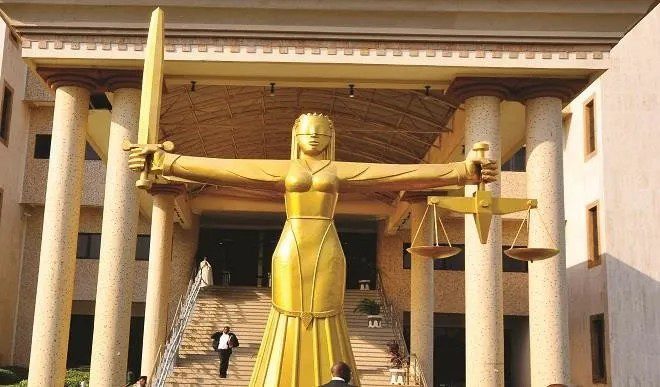
In a major development that highlights Nigeria’s ongoing fight against corruption, the Federal High Court in Abuja has ordered the permanent forfeiture of ₦3.44 billion in cash along with several high-value properties linked to Salihu Nuhu Jamari, a former senior official of Nigerian National Petroleum Company Limited.
The ruling, delivered on Tuesday, March 31, 2026, by Justice Joyce Abdulmalik, officially transfers ownership of the assets to the Federal Government of Nigeria. This decision brings to a close a high-profile legal process initiated by the Economic and Financial Crimes Commission, widely known as the EFCC.
A Closer Look at the Forfeiture
The court’s decision followed a non-conviction-based forfeiture process carried out under Section 17 of the Advance Fee Fraud and Other Fraud-Related Offences Act. This legal pathway allows authorities to seize assets suspected to be proceeds of unlawful activity even without a criminal conviction, provided there is sufficient evidence to justify the action.
In this case, the court agreed with the EFCC’s position that the assets in question were proceeds of illicit dealings connected to major energy projects overseen by Jamari during his time as Managing Director of the NNPC Gas and Power Investment Company Limited.
Get TikTok SEO Cheat here
The Financial Assets
At the center of the case is a massive sum of ₦3,444,000,000.00.
According to the EFCC, this money was not legitimately earned but instead formed part of a carefully structured kickback arrangement. Investigators alleged that funds from large-scale government-backed energy projects were diverted and funneled into private accounts linked to Jamari.
The recovered money is currently held in an EFCC recovery account. With the court’s final order now in place, the funds will be transferred into the Federation Account, making them available for public use.
The Seized Properties
In addition to the cash, the court also ordered the forfeiture of three high-end properties located in some of Nigeria’s most expensive areas.
One of the properties is an uncompleted six-bedroom semi-detached duplex with boys’ quarters situated in Asokoro, Abuja, a district known for housing top government officials and diplomats.
Another is a luxury two-bedroom apartment located in Osborne Foreshore II, Ikoyi, Lagos, one of the most exclusive residential zones in the country.
The third property is a commercial restaurant building in Lokogoma, Abuja, highlighting that the assets linked to the case were not limited to residential investments but also extended into commercial ventures.
Read more on:
- “Admin Night” Productivity: How to Turn Boring Chores into High-Focus Power Sessions
- Naira vs Dollar: A Steadier Finish to Q1 in the Cardoso Era
- From Business Deals to Prison Cell: Idowu Gets 30 Years for Fraud
How the Investigation Unfolded
The EFCC investigation was led by investigator Abdullahi Aminu and began after the agency received a petition dated April 28, 2025. What followed was a detailed probe that uncovered a network of financial misconduct involving conspiracy, bribery, and money laundering.
At the heart of the case was a system that allegedly allowed Jamari to use his official position to influence project outcomes for personal gain.
The Alleged Kickback Scheme
Court documents revealed that Jamari had connections to two private companies where he served as both a director and a signatory.
These companies, Cumulus Energy Limited and Pius and Phillips Petroleum Limited, were said to have acted as channels through which illicit payments were received.
According to the EFCC, contractors who were awarded major government projects were required to funnel a portion of the funds back through these companies. This arrangement effectively turned public infrastructure projects into a source of private enrichment.
The projects involved included the Maiduguri Emergency Power Project, the Abuja Independent Power Project, and the Benin Gas Plant Project. All three were high-value initiatives aimed at improving Nigeria’s energy supply.
Investigators argued that Jamari maintained significant influence over these projects and used that influence to ensure that funds were redirected into accounts under his control.
The Legal Process and Final Decision
The journey to the final forfeiture began on February 25, 2026, when the court granted an interim forfeiture order. This temporary order allowed the EFCC to take initial control of the assets while giving room for any interested parties to contest the action.
As required by law, the EFCC published notices in national newspapers, inviting members of the public or any stakeholders to come forward and show cause why the assets should not be permanently forfeited.
Interestingly, no one stepped forward to challenge the forfeiture.
In a move that surprised many observers, Jamari himself did not oppose the proceedings. His legal representative, Maryam Abba, informed the court that her client had filed an affidavit of non-contestation. This meant that he chose not to defend his ownership of the assets or dispute the claims made by the EFCC.
With no opposition from either the defendant or the public, the court found the EFCC’s case to be valid and granted the final forfeiture order.
Read more on:
- Meet “Private Sammy”: Inside the Galaxy S26 Ultra
- Gaming Power in a Tablet Body: Meet the Z13-KJP
- Your Network Fails, You Get Paid: Here’s How It Works
Wider Implications for NNPC
This case is not an isolated incident but part of a broader effort to reform and sanitize operations within the Nigerian National Petroleum Company Limited.
Earlier in March 2026, the EFCC returned another ₦3.9 billion in recovered funds directly to the organization. This move was seen as part of an ongoing collaboration between government agencies to promote transparency and accountability.
During that handover, Mumuni Dagazau, Executive Vice President of Downstream at NNPC, emphasized the importance of institutional cooperation in addressing long-standing challenges within the sector.
What Comes Next
With the court’s final ruling now in effect, the Federal Government is expected to dispose of the forfeited properties through the Inter-Ministerial Committee on Disposal of Forfeited Assets.
The proceeds from the sale of these properties, along with the recovered cash, are likely to be redirected into national development efforts. There is a strong possibility that the funds could be included in the 2026 or 2027 national budget to support infrastructure and public services.
A Strong Message Going Forward
This case sends a clear signal about the direction Nigeria is taking in its fight against corruption. It shows that public office holders can no longer assume that illicit wealth will remain hidden or beyond the reach of the law.
With improved investigative tools, stronger inter-agency collaboration, and increasing use of advanced technologies in financial tracking, it is becoming more difficult to conceal proceeds of crime.
Ultimately, this ruling reinforces a growing commitment to accountability and serves as a warning that misuse of public trust will carry serious consequences.
Read more on: