



The atmosphere across Nigeria’s political landscape has changed dramatically following the emergence of the Nigeria Democratic Congress as a powerful new opposition platform. What initially appeared to be another minor political movement has rapidly transformed into a national conversation capable of reshaping the future of presidential politics in the country.
At the center of this political earthquake stands Peter Obi, whose formal acceptance into the NDC and subsequent approval for the party’s Southern zoned presidential ticket has triggered intense reactions from supporters, critics, analysts, and political stakeholders nationwide.
For millions of Nigerians who have spent years demanding an alternative to the traditional power structures dominated by the major political parties, the development represents far more than a simple party defection. It symbolizes the birth of what many now describe as the most coordinated opposition realignment in modern Nigerian politics.
The significance of this development cannot be overstated.
Get TikTok SEO Cheat here
For years, opposition politics in Nigeria has suffered from fragmentation, ego battles, regional mistrust, conflicting ambitions, endless court disputes, and weak grassroots coordination. Several movements that appeared promising eventually collapsed under the weight of internal conflicts and leadership struggles. Voters became increasingly frustrated as political parties that promised reform often descended into confusion shortly after elections.
This latest political arrangement appears designed specifically to avoid those previous mistakes.
The Nigeria Democratic Congress has moved aggressively to establish itself as a structured coalition platform capable of bringing together influential political figures, youth driven movements, grassroots activists, digital campaign structures, northern political blocs, southern reform advocates, and undecided voters searching for a credible national alternative.
The approval of Peter Obi for the Southern zoned ticket immediately sends a message that the party intends to institutionalize regional balancing and power rotation from the beginning. This strategic decision also strengthens the perception that the NDC is attempting to build a coalition rooted in political inclusiveness rather than personal dominance.
Even more significant is the growing partnership between Obi and Rabiu Musa Kwankwaso under what insiders now call the “OK Movement.” The alliance between both figures has created enormous political excitement because it combines two of the most energetic political support bases in the country.
On one side stands Obi’s youthful and digitally connected support movement that became one of the most influential political communities in Nigeria’s democratic history.
On the other side stands Kwankwaso’s disciplined grassroots political structure, especially dominant across several northern regions through the powerful Kwankwasiyya movement.
Together, both camps are attempting to create a political machine capable of matching the ruling establishment both online and on the ground.
What makes this moment even more historic is the speed at which the NDC has evolved from a relatively unknown platform into a national political conversation. Within a short period, the party has moved from legal recognition battles into becoming the potential rallying point for a large segment of Nigeria’s opposition forces.
Political observers now believe the country may be entering one of the most competitive electoral cycles since the return to democratic governance.
The implications extend beyond party politics.
This realignment could influence regional alliances, youth participation, campaign financing, voter turnout patterns, digital political mobilization, and even the internal calculations of rival political parties already preparing for the next presidential contest.
For ordinary Nigerians facing economic hardship, unemployment, insecurity, inflation, and declining trust in political institutions, the rise of the NDC introduces a fresh layer of political expectation. Many voters are no longer merely interested in campaign speeches. They are searching for organizational stability, ideological clarity, and a credible pathway toward governance reform.
The NDC leadership appears fully aware of this reality.
Rather than presenting itself as just another opposition platform, the party is carefully branding itself as a corrective political movement intended to unite fragmented opposition structures into one coordinated national force.
The greenlighting of Peter Obi for the Southern zoned ticket therefore marks the beginning of a much larger political project whose consequences could reverberate across every region of the country.
The Rise of the Nigeria Democratic Congress
The emergence of the Nigeria Democratic Congress did not happen by accident. Behind the scenes, months of strategic consultations, political negotiations, alliance building, and legal maneuvering laid the foundation for what has now become one of the most talked about political platforms in the country.
The party was founded under the influence of Seriake Dickson, whose experience within Nigeria’s traditional political establishment gave him a unique understanding of the weaknesses crippling opposition politics.
Unlike older opposition parties burdened by years of factional disputes and historical rivalries, the NDC entered the political scene with a relatively clean institutional identity.
This proved highly attractive to politicians and activists frustrated by the endless crises affecting existing political structures.
The party’s legal journey also strengthened its credibility.
After initial resistance regarding its official recognition, the eventual legal victory that secured the party’s registration gave the NDC an image of resilience and legitimacy. Supporters interpreted the victory as evidence that the party was prepared to fight institutional battles from the very beginning.
For many observers, the NDC quickly transformed from a minor political organization into a symbolic “safe political shelter” for politicians seeking stability outside the dominant traditional parties.
That perception intensified dramatically after Peter Obi’s entry into the party.
Why Peter Obi’s Approval Changes Everything
The formal approval of Peter Obi for the Southern zoned presidential ticket carries deep political symbolism.
First, it signals that the NDC is fully prepared to organize its political structure around national balancing and strategic inclusiveness.
Second, it confirms Obi’s position as the central figure around whom the party intends to mobilize large scale public support.
Third, it demonstrates that the NDC leadership understands the emotional and political energy still surrounding the Obidient movement.
Despite previous political setbacks and internal party crises elsewhere, Obi has maintained remarkable popularity among young Nigerians, urban professionals, students, civil society groups, and reform minded voters.
His reputation for fiscal discipline, governance reform messaging, and economic accountability continues to resonate strongly among supporters searching for an alternative political culture.
Within the NDC, Obi’s candidacy serves several strategic purposes simultaneously.
Strategic Advantages of Obi’s Emergence
| Political Factor | Strategic Impact |
|---|---|
| Southern zoning | Reinforces power rotation narrative |
| Youth popularity | Expands digital mobilization capacity |
| Reform image | Attracts undecided middle class voters |
| National recognition | Gives instant visibility to NDC |
| International attention | Elevates party credibility globally |
Political insiders believe the NDC leadership concluded that Obi already possesses one of the strongest independent political brands in the country. By integrating that brand into a newly structured political platform, the party gains instant national relevance.
This is precisely why the announcement has generated such widespread national attention.
The “OK Movement” and the Obi Kwankwaso Alliance
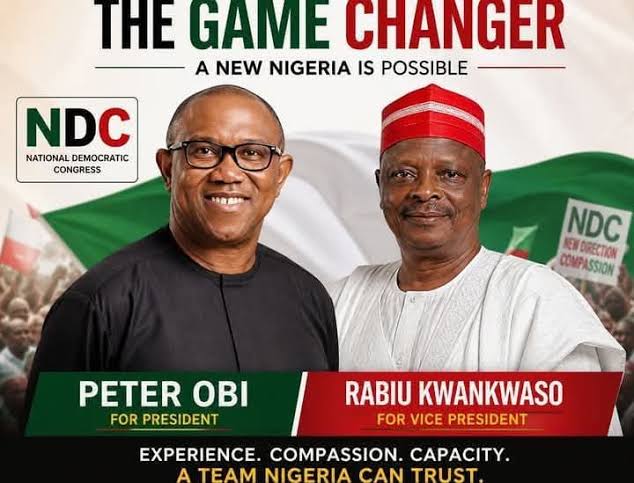
Perhaps the most politically explosive aspect of this entire development is the growing alliance between Peter Obi and Rabiu Musa Kwankwaso.
For years, political analysts speculated about the possibility of both camps working together. The logic behind such an alliance has always been obvious.
Obi commands massive emotional support among youths and southern voters.
Kwankwaso commands deep grassroots loyalty across several northern regions.
Separately, both movements remain influential.
Combined, they become a formidable national force.
The “OK Movement” seeks to achieve exactly that.
Sources within the party suggest that negotiations between both camps focused heavily on long term political trust, regional balancing, and electoral sustainability.
One of the most discussed elements of the arrangement reportedly involves a single term understanding that would allow rotational leadership continuity between both blocs.
Although political negotiations of this nature are often fluid, the symbolism behind the arrangement is extremely powerful.
It sends a message that the alliance is attempting to reduce the historical mistrust that frequently undermines national coalitions in Nigeria.
The Massive Power of Grassroots and Digital Mobilization
One of the greatest strengths of this new alliance lies in its unusual organizational combination.
The Obidient movement revolutionized digital political engagement by turning social media into a powerful electoral mobilization tool. Young Nigerians utilized online platforms for voter education, campaign organization, fundraising, political debates, and grassroots coordination.
Meanwhile, the Kwankwasiyya structure perfected traditional political mobilization through physical community engagement, loyal ward level networks, and disciplined grassroots organization.
The merger of both systems creates an extraordinary political structure.
Comparing the Two Political Machines
| Structure | Major Strength |
|---|---|
| Obidient Movement | Digital influence and youth engagement |
| Kwankwasiyya Movement | Grassroots discipline and northern reach |
| NDC Coalition Framework | National integration strategy |
Political analysts believe this integration could significantly improve polling unit coordination, voter turnout organization, election monitoring, volunteer management, and nationwide campaign penetration.
For the ruling establishment, this represents a potentially dangerous development.
The Atiku Question and the Risk of Opposition Fragmentation
While the Obi Kwankwaso alliance appears increasingly organized, one major uncertainty remains unresolved.
Atiku Abubakar continues to maintain significant political influence within opposition circles.
This creates a difficult strategic dilemma for anti establishment forces.
If multiple heavyweight opposition figures eventually contest separately, the opposition vote could once again become fragmented. Such a scenario would likely benefit the ruling party by dividing reform minded voters across different platforms.
However, supporters of the NDC argue that the early consolidation around Obi and Kwankwaso could eventually pressure other opposition figures into broader negotiations.
The coming months will therefore be critical.
Nigeria may either witness the emergence of an unprecedented unified opposition coalition or another cycle of divided ambitions and competing candidacies.
Why Nigerians Are Paying Close Attention
The excitement surrounding the NDC extends beyond elite political calculations.
Across the country, ordinary citizens are watching developments closely because many Nigerians feel politically exhausted.
Economic hardship, inflation, unemployment, insecurity, rising living costs, and declining institutional trust have created widespread frustration.
Many voters now prioritize competence, organizational discipline, and policy direction over traditional party loyalty.
This explains why the NDC’s messaging strategy appears heavily focused on unity, internal stability, conflict prevention, and institutional coordination.
Peter Obi himself reportedly emphasized the importance of avoiding internal legal battles and factional disputes that weakened previous political movements.
The party leadership appears determined to build a “litigation resistant” political structure capable of surviving internal tensions before they become public crises.
Political Realignment Summary
| Component | Strategic Objective | Current Status |
|---|---|---|
| Presidential Candidate | Peter Obi | Approved |
| Northern Alliance Figure | Rabiu Musa Kwankwaso | Integrated |
| Zoning Structure | Southern Ticket | Adopted |
| Opposition Coalition | OK Movement | Active |
| Party Leadership Base | NDC National Structure | Expanding |
| Youth Mobilization | Obidient Networks | Operational |
| Grassroots Mobilization | Kwankwasiyya Structure | Integrated |
A Defining Political Turning Point
The greenlighting of Peter Obi for the NDC Southern zoned ticket may ultimately become one of the defining political turning points in Nigeria’s democratic evolution.
This is no longer simply about a candidate searching for a platform.
It is about the attempted reconstruction of opposition politics itself.
The NDC is trying to build something Nigerian opposition parties have historically struggled to sustain, namely a coalition built on strategic compromise, regional balancing, organizational discipline, and long term coordination.
Whether the project succeeds or collapses under the pressure of ambition and political rivalry remains uncertain.
But one reality is already clear.
Nigeria’s political equation has changed significantly.
The ruling establishment now faces an opposition movement that appears more coordinated, more strategic, more nationally balanced, and far more conscious of the mistakes that weakened previous alliances.
For supporters of the movement, this moment represents hope.
For rivals, it represents a serious warning.
And for millions of undecided Nigerians watching from across the country, the emergence of the NDC may mark the beginning of a completely new political chapter.
Read More On: