

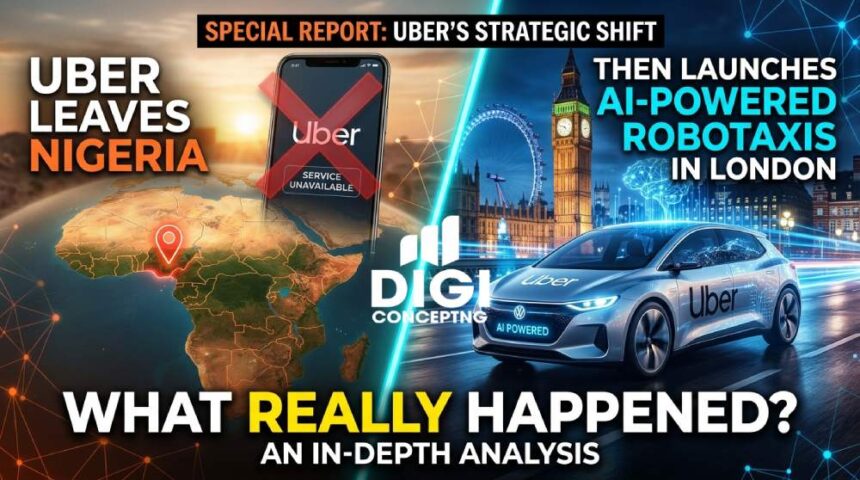
For many Nigerians, Uber was more than just another ride-hailing app. It was part of the changing face of transportation in Lagos and other major cities. For 12 years, Nigerians could open an app, request a ride and get a driver to their doorstep without having to negotiate a fare by the roadside.
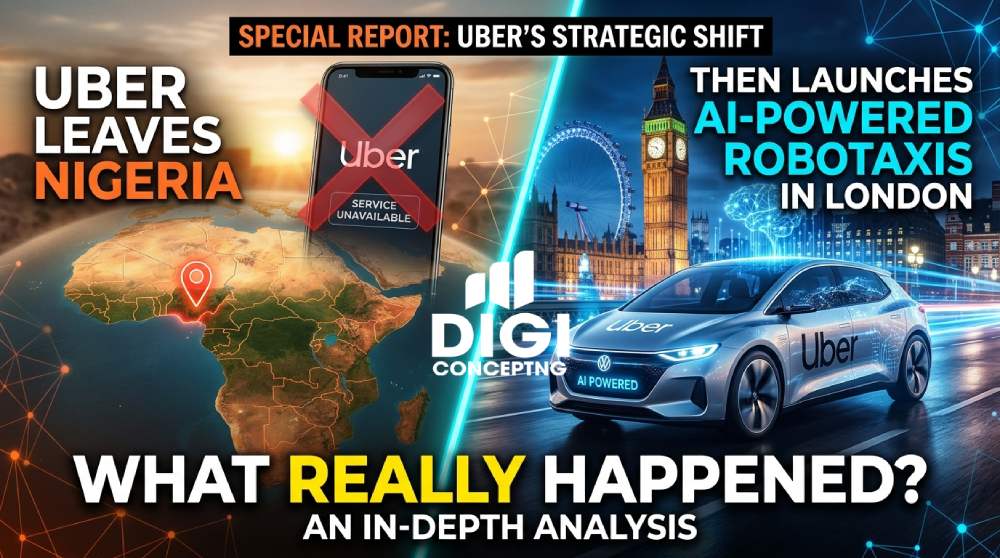
Then, on September 2, 2026, Uber left.
And barely a day later, the company was making another major transportation announcement, this time in London, where it launched supervised autonomous rides powered by artificial intelligence.
That timing is hard to ignore.
Get TikTok SEO Cheat here
But is Uber replacing Nigeria with AI taxis?
Not exactly.
The reality is more interesting.
Need website? Check our Web Dev services
Read also:
Uber has left Nigeria after 12 years
Uber announced that it would wind down its Nigerian operations effective September 2, 2026, bringing an end to a 12-year presence that began with its launch in Lagos in 2014.
The company said the decision followed a “thorough review” of its business and described it as a difficult decision. Uber did not publicly provide a detailed breakdown of the financial or operational reasons behind the exit.
Its departure comes at a difficult time for the Nigerian ride-hailing industry.
Fuel prices have risen sharply, inflation has increased the cost of vehicle ownership and maintenance, and currency volatility has made many operating expenses more expensive. At the same time, competition among ride-hailing platforms has intensified.
For drivers, the economics have become increasingly difficult.
For platforms, maintaining a profitable ride-hailing business while keeping fares attractive to passengers is an even bigger challenge.
Uber’s exit therefore leaves an obvious question:
Why leave a market with millions of potential riders while investing heavily in the future of transportation elsewhere?
The answer may be found in what Uber is building next.
One day later, Uber launches an AI taxi service in London
On September 3, Uber announced that it had launched autonomous rides in London in partnership with British artificial intelligence company Wayve.
The vehicles are electric Ford Mustang Mach-E cars equipped with Wayve’s AI Driver technology.
For the first phase, these are not completely driverless taxis.
A trained and TfL-licensed private-hire driver remains inside the vehicle to supervise the journey.
Passengers requesting UberX, Uber Electric or Uber Comfort in selected areas of London can potentially be matched with one of the autonomous vehicles at no additional cost. Riders can also choose not to take the autonomous option.
It is a significant milestone because this is the first time autonomous ride-hailing has become available to the public in the United Kingdom.
And that is where the Nigeria story becomes particularly interesting.
So, did Uber leave Nigeria because of AI?
There is no evidence that Uber has said this.
The company has not announced that it is leaving Nigeria to redirect drivers, vehicles or resources into robotaxis.
In fact, Uber said its decision to wind down Nigeria and Uganda followed a review of its operations and business priorities. Reuters also reported that rising fuel costs, inflation, currency volatility and increasing competition have put pressure on ride-hailing businesses in Nigeria.
However, there is a bigger strategic shift happening inside Uber.
The company is investing heavily in autonomous mobility and has said it expects to put more than $10 billion toward robotaxi partnerships in the coming years. At the same time, Uber announced plans to cut around 3,300 jobs globally as part of a restructuring designed to simplify the business and redirect resources towards growth areas, including autonomous vehicle technology.
So the better way to understand the situation is not:
“Uber left Nigeria to build AI taxis.”
It is:
“Uber is becoming increasingly focused on a future where its ride-hailing platform can operate with autonomous vehicles, while it is also reassessing markets where the economics of traditional ride-hailing are under pressure.”
That distinction matters.
What exactly is Uber’s AI taxi?
The technology behind the London launch comes from Wayve, a London-based AI company that has been developing autonomous driving technology since 2017.
Unlike a traditional taxi driver who learns through experience, Wayve’s AI Driver learns from driving data and uses cameras, sensors and artificial intelligence to understand its surroundings and make driving decisions.
One of the company’s key ideas is that its technology does not depend on traditional high-definition maps for every road.
That could become important for autonomous vehicles because roads are constantly changing.
A construction site appears.
A traffic officer redirects vehicles.
A delivery van blocks a lane.
A pedestrian suddenly crosses the road.
A human driver has to interpret these situations in real time.
Wayve’s approach is designed to allow the AI Driver to learn and adapt to these kinds of real-world environments.
But there is still a human behind the wheel
This is one detail that should not get lost in the excitement around “AI taxi”.
The London service is currently supervised autonomy.
A trained human driver is still inside the vehicle.
That means the technology has not reached the point where Nigerians should imagine a completely empty Uber arriving at your gate in Lagos.
At least, not yet.
Uber says it intends to gradually expand the number of autonomous vehicles as rider demand, technology and regulation allow.
That gradual approach is important because autonomous driving is not simply a technology problem.
It is also a regulatory, safety, insurance, infrastructure and public-trust problem.
And this is where Nigeria’s story gets interesting
Nigeria is not unfamiliar with artificial intelligence.
The country is increasingly exploring AI across banking, education, healthcare, agriculture, customer service and other industries.
The bigger question is whether autonomous mobility can eventually work in a Nigerian environment.
Imagine an autonomous taxi navigating Lagos traffic.
Not an empty road in a technology demonstration.
Actual Lagos.
A danfo suddenly stopping in front of it.
A keke moving across two lanes.
A motorbike appearing from nowhere.
A pedestrian crossing where there is no pedestrian crossing.
A road that looked perfectly fine yesterday but has a new pothole today.
A LASTMA officer directing traffic differently from the traffic light.
That is the real test.
The challenge for autonomous vehicles in Nigeria would not simply be teaching an AI how to drive.
It would be teaching it how to understand Nigerian roads.
And that could take a very different kind of data, testing and regulatory framework.
What happens to Nigerian Uber riders now?
Uber’s exit means Nigerian riders will have to rely on the other ride-hailing platforms still operating in the market.
Bolt has already said that Nigeria remains an important market and that it is committed to strengthening its operations and creating more opportunities for riders and drivers. Other platforms, including inDrive and LagRide, also remain part of the Nigerian mobility landscape.
For consumers, the immediate impact is simple:
one of the biggest names in Nigerian ride-hailing is gone.
For drivers, however, the consequences could be more complicated.
Uber’s departure removes another platform through which drivers could find passengers and earn income. At the same time, the reduction in competition could give remaining platforms an opportunity to attract more drivers and riders.
The market will now be watching what Bolt, inDrive, LagRide and other mobility companies do next.
Could Nigeria eventually get robotaxis?
Eventually? Possibly.
Soon? That is a different question.
Autonomous vehicles require more than sophisticated AI.
They need regulations that clearly define who is responsible when something goes wrong. They need insurance frameworks. They need reliable mapping and data systems. They need vehicles and sensors capable of handling local conditions. They need public acceptance.
And perhaps most importantly, they need extensive testing on Nigerian roads.
The interesting thing is that Wayve itself is positioning its technology as something that can scale across different vehicles and locations rather than being restricted to one specific type of car or road network. The company says its AI Driver is designed to work across vehicles and geographies.
That means Africa cannot simply be dismissed as irrelevant to the long-term robotaxi conversation.
But Nigeria will need to create the environment for that technology to work.
The bigger lesson from Uber’s exit
Perhaps the biggest lesson is not about Uber at all.
It is about how quickly the global transportation business is changing.
For years, the ride-hailing revolution was built around one basic idea:
connect a passenger with a human driver through an app.
The next phase could look very different.
The app may remain.
The passenger may remain.
The car may remain.
But the driver could eventually disappear.
That shift has enormous implications for companies, drivers, governments and consumers.
For Uber, the question is no longer simply how many rides it can facilitate.
It is increasingly about how those rides will be delivered in the future.
And while Nigeria has just watched Uber close one chapter of its story, London has watched the company open another.
Nigeria has not been left behind, but it has a choice
Uber leaving Nigeria should not automatically be interpreted as a verdict on the country’s technology potential.
Nigeria remains one of Africa’s largest technology markets, with a young population, rapidly growing digital adoption and a huge need for better urban mobility.
But technology companies need viable markets.
They need infrastructure.
They need predictable regulation.
They need customers who can afford their services.
And they need business models that make economic sense.
The next generation of mobility companies will be watching how Nigeria responds.
Because the future of transportation may not be about building another Uber.
It may be about building the AI that drives the Uber.
For now, Nigerians will have to keep dealing with the realities of Lagos traffic the old-fashioned way.
But somewhere in London, a car is already learning how to drive itself.
And that may be the more important Uber story.
Read More On: