


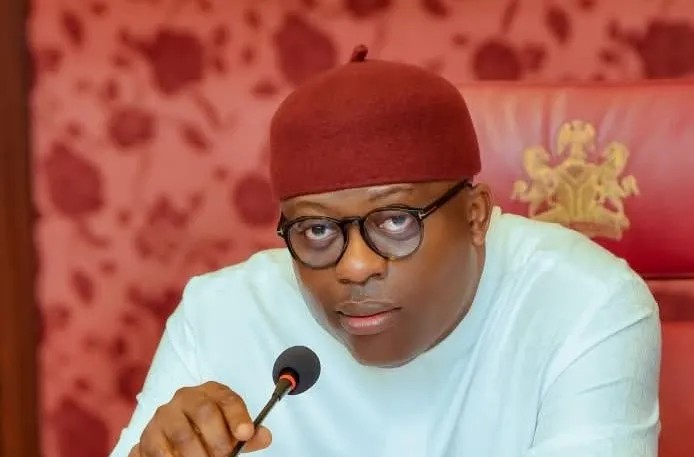
Rivers State has once again become the epicenter of Nigeria’s most explosive political confrontation, as reports emerging from Abuja suggest that Governor Siminalayi Fubara dramatically walked out of a crucial screening exercise organized by the All Progressives Congress. The development has triggered intense nationwide debate, with political observers now questioning whether the Governor has effectively abandoned his quest to secure the party’s governorship ticket.
What was expected to be a routine internal exercise quickly transformed into a spectacle that exposed the widening cracks inside the ruling party’s Rivers structure. The atmosphere surrounding the screening venue reportedly reflected deep tension, uncertainty, and suspicion among party stakeholders who have closely followed the prolonged supremacy battle between Governor Fubara and the Minister of the Federal Capital Territory, Nyesom Wike.
For months, the rivalry between both political figures has dominated conversations across Nigeria’s political landscape. What initially appeared to be a disagreement between a political godfather and his successor has now evolved into a fierce struggle for total control of Rivers State’s political machinery. The latest events surrounding the APC screening exercise appear to have pushed that conflict into an entirely new phase.
Political insiders now believe the Governor’s reported exit from the screening venue may represent more than frustration. To many observers, it signals a strategic political recalibration designed to preserve his influence ahead of a potentially bruising battle for survival within the party structure.
Get TikTok SEO Cheat here
Across Rivers State, reactions have been swift and emotional. Supporters of the Governor view the incident as evidence that the process had already been manipulated against his faction, while loyalists of the Wike camp insist that party discipline and internal regulations must prevail regardless of political status.
As uncertainty spreads, the larger implication remains deeply significant. Rivers State is not just another political battleground. It remains one of Nigeria’s most economically influential states and a major pillar in the South South political equation. Any major realignment involving Governor Fubara could dramatically reshape alliances, voting calculations, and party strength far beyond the state itself.
The Dramatic Exit That Sparked National Attention
Eyewitness accounts from the screening venue described a visibly tense atmosphere from the moment Governor Fubara arrived. Unlike previous political appearances where the Governor maintained a calm and composed public posture, sources claimed his body language reflected deep dissatisfaction.
Party members present at the venue reportedly noticed unusual movements among officials and aspirants aligned with different factions of the party. Within a short period, murmurs began spreading that several names connected to the Governor’s political camp had encountered serious complications during the screening process.
Then came the moment that stunned observers.
Reports indicate that Governor Fubara suddenly exited the venue without formally addressing journalists or party delegates gathered outside. His refusal to speak immediately intensified speculation that something significant had gone wrong behind closed doors.
The silence that followed became even louder than words.
Political analysts believe the walkout may have been triggered by the realization that the screening process had already tilted heavily in favor of candidates loyal to Wike’s political bloc. Others argue the Governor may have chosen to leave in order to avoid legitimizing a process his supporters allegedly considered compromised from the beginning.
Regardless of the motive, the optics of the incident delivered a powerful political message across Nigeria.
The Crushing Blow Against Fubara’s Political Camp
Perhaps the most devastating aspect of the unfolding crisis is the reported mass disqualification of aspirants linked to the Governor’s faction.
Sources within the party structure revealed that numerous individuals believed to be politically loyal to Fubara were allegedly denied clearance to proceed further in the internal process. Among the affected names were several influential grassroots mobilizers and key political figures who had played visible roles in strengthening the Governor’s support base.
Particularly symbolic was the reported disqualification involving allies connected to former factional Speaker Victor Oko Jumbo.
To many observers, the development effectively weakened the operational strength of the Governor within the APC structure.
The implication became immediately clear.
Without loyal political foot soldiers positioned across the party framework, Governor Fubara risks becoming politically isolated within the very party he recently embraced.
Power Balance Inside Rivers APC
| Political Bloc | Major Figures | Current Position |
|---|---|---|
| Fubara Camp | Siminalayi Fubara, Victor Oko Jumbo | Facing setbacks and alleged disqualifications |
| Wike Camp | Nyesom Wike, Tony Okocha | Appears structurally dominant |
| Neutral Stakeholders | Independent APC leaders | Monitoring developments cautiously |
Why The Wike Factor Remains Central
No analysis of the Rivers political crisis can be complete without examining the towering influence of Nyesom Wike.
For years, Wike maintained extraordinary control over Rivers political structures, grassroots networks, and strategic alliances. His influence extended beyond party leadership into local government systems, legislative relationships, and political mobilization structures.
Governor Fubara originally emerged under that formidable political umbrella.
However, the relationship between both men gradually deteriorated following disagreements surrounding governance control, political appointments, and institutional loyalty within the state.
What began as quiet tension soon exploded into open confrontation.
Since then, Rivers politics has operated under near constant instability, with competing factions struggling for legitimacy and dominance.
The latest screening controversy appears to confirm that the battle is no longer merely about influence. It has evolved into a full scale contest for political survival.
Growing Rumors Of A Fresh Political Realignment
Following the reported walkout, speculation intensified regarding Governor Fubara’s next political destination.
Political circles have increasingly linked the Governor with possible alignment discussions involving alternative political platforms. Among the names repeatedly mentioned is the Nigeria Democratic Congress, a party that has recently attracted attention as a potential emerging force.
Although official confirmation remains absent, insiders believe several political actors have already initiated discreet negotiations aimed at positioning themselves ahead of any major defection announcement.
Meanwhile, government officials close to the Governor continue insisting that he remains loyal to the APC.
Yet political observers remain unconvinced.
Within Nigeria’s political culture, public declarations of loyalty are often maintained until strategic exits become fully finalized behind the scenes.
Political Implications Beyond Rivers State
The unfolding crisis carries consequences far beyond Rivers State alone.
Rivers remains one of Nigeria’s most financially powerful states and an essential prize in national electoral calculations. Any significant weakening of the APC’s unity within the state could affect broader political strategies tied to future national contests.
Analysts warn that losing Governor Fubara’s support base could create substantial electoral complications for the ruling party across the South South region.
Many grassroots supporters who currently identify with the Governor may choose personal loyalty over party loyalty if the crisis deepens further.
That possibility alone has intensified pressure on national party leaders to prevent a total breakdown in negotiations.
Possible Scenarios Moving Forward
Potential Outcomes Of The Crisis
| Scenario | Possible Impact |
|---|---|
| Reconciliation Effort | Temporary peace between both factions |
| Court Intervention | Prolonged legal and political uncertainty |
| Defection To Another Party | Major political realignment in Rivers |
| Independent Political Structure | Emergence of a new power coalition |
Conclusion
The reported exit of Governor Siminalayi Fubara from the APC screening exercise may ultimately become one of the defining political moments in Rivers State’s contemporary history.
What happened in Abuja was not merely a disagreement inside a party building. It symbolized the deepening collapse of trust between two powerful political camps whose alliance once appeared unbreakable.
For Governor Fubara, the coming weeks may determine whether he emerges as an independent political force capable of surviving outside established structures or becomes politically cornered within an increasingly hostile environment.
For the APC, the crisis represents a dangerous balancing act between preserving internal dominance and avoiding a fragmentation that could weaken the party’s broader ambitions.
As tension continues to rise, Rivers State now watches anxiously, aware that the next political move from either camp could completely redraw the future of power in the oil rich state.
Read More On: