

Introduction
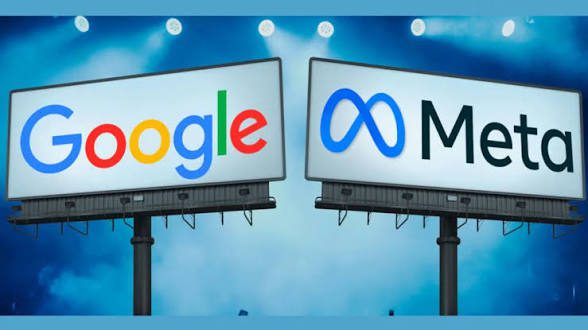
The digital advertising landscape has officially reached a historic crossroads: Meta overtakes Google in ad revenue for the first time. For years, Google’s search dominance seemed untouchable, but the 2026 fiscal data reveals a massive shift in how brands allocate their budgets. As Meta’s ad revenue growth continues to climb, driven by advanced AI integration and the explosion of short-form video, marketers are left wondering if this “flip” is a temporary surge or a permanent change in digital marketing market share. In this analysis, we break down why the Meta vs. Google rivalry has reached a breaking point and what this means for the future of your advertising strategy.
The Shift in Digital Dominance: How Meta Flipped the Script
The margin between the two giants is narrow, yet the trajectory tells a story of divergent momentum. While Google remains a massive force, Meta is growing at exactly double the speed of the search giant.
- Meta Projected 2026 Revenue: $243.46 Billion (26.8% Market Share)
- Google Projected 2026 Revenue: $239.54 Billion (26.4% Market Share)
- Meta Growth Rate (2026): 24.1% (Accelerated from 22.1% in 2025)
- Google Growth Rate (2026): 11.9% (Flat compared to previous years)
- Concentrated Power: Together with Amazon (projected at $82 billion), the “Big Three” now control 62.3% of all global digital ad spend.
In 2025, Google held a comfortable lead with approximately $214 billion compared to Meta’s $196 billion. The fact that Meta closed an $18 billion gap in just twelve months is being hailed by analysts as an unprecedented feat for a company of its scale.
Why Meta Overtook Google: Analyzing the 2026 Ad Revenue Data
Analysts attribute this historic “flip” to three major pillars of Meta’s 2026 strategy:
1. The “Advantage+” AI Efficiency Loop
Meta’s Advantage+ automated ad suite has reached maturity. By removing the need for manual audience targeting and allowing AI to optimize creative assets in real-time, Meta has significantly lowered the “barrier to ROI.”
- Creative Velocity: Marketers are now focusing on producing high volumes of video content rather than tweaking keyword bids.
- Incremental Attribution: New Q4 2025 models for Meta’s attribution tools drove a 24% increase in incremental conversions, proving to advertisers that their spend on Meta is working more effectively than ever.
2. The Short-Form Video Goldmine: Instagram Reels
While Google’s YouTube Shorts is growing, Instagram Reels has successfully evolved from an engagement tool into a primary commerce engine. - Reels monetization has reached parity with Feed ads, and with nearly 10% of daily views now coming from content generated or enhanced by AI, the inventory is more relevant to users than ever before.
3. The Rise of “Discovery-Led” Commerce
Google captures intent once a user knows what they want (Search). Meta’s AI, powered by its new Lattice and Muse Spark models, predicts what a user wants before they even know they want it. - By successfully launching ads on WhatsApp and Threads, Meta has created a “Family of Apps” ecosystem that captures users at every touchpoint, from initial discovery on Instagram to final customer support on WhatsApp.
What the Meta Revenue Flip Means for Your Digital Marketing Strategy
As we navigate the remainder of 2026, the implications for digital strategy are profound:
Get TikTok SEO Cheat here
- The Decline of Search Dominance: For the first time in ten years, Google’s share of the U.S. search ad market is expected to drop below 50% (to 48.5%). This is due to users moving toward “Agentic Search” (AI chatbots) and social media for discovery.
- Automation is Mandatory: Google is fighting back by auto-migrating legacy campaigns into AI Max for Search, but Meta currently holds the “first-mover advantage” in full-funnel automation.
- Content as the New Keyword: In a world where AI handles the targeting, Content is the only lever left. Brands that invest in “high-bandwidth” 4K video and AR try-ons are seeing the highest performance gains on Meta’s platforms.
Can Google Reclaim the Top Spot in Ad Revenue?
The 2026 revenue “flip” proves that the market is rewarding Predictive AI over Intent-Based Search. While Google remains the king of information, Meta has become the king of influence. For marketers, the lesson is clear: The most valuable ad dollar is no longer the one spent on someone looking for a product, but the one spent on someone who is about to be convinced they need it.
Read More On: