


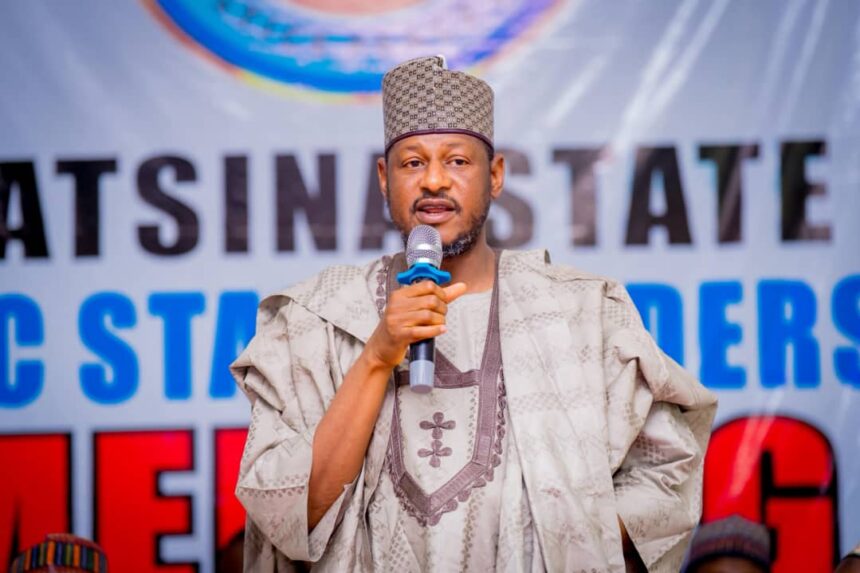
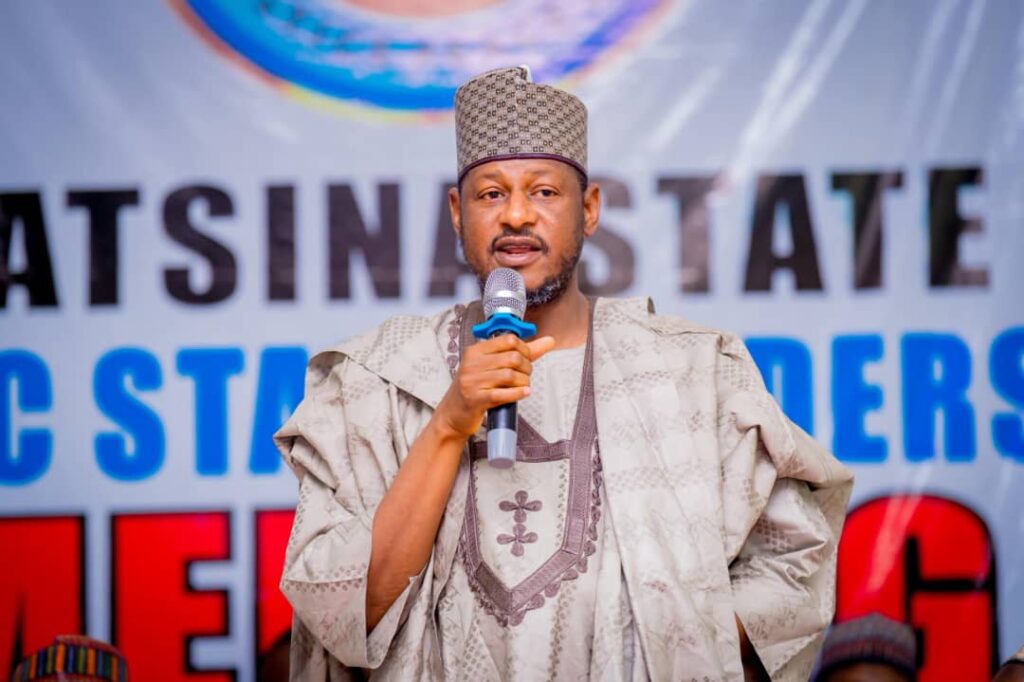
The political atmosphere across Katsina State has taken a dramatic turn following the official affirmation of Governor Dikko Umaru Radda as the governorship candidate of the ruling All Progressives Congress ahead of the next electoral cycle.
What unfolded at the People’s Square within the Government House complex was far more than a routine party exercise. It was a carefully orchestrated political gathering that reflected the depth of influence currently surrounding the governor and the determination of the ruling party to preserve internal stability before the general elections.
For several hours, party stakeholders, ward executives, statutory delegates, youth mobilizers, women leaders, lawmakers, traditional political actors, and loyal party faithful occupied the venue in an atmosphere charged with chants, applause, strategic consultations, and symbolic displays of unity. The exercise eventually culminated in a thunderous voice affirmation that handed Governor Radda the party’s mandate to seek another tenure in office.
The consensus arrangement adopted by the party immediately became one of the most talked about political developments in Northern Nigeria. Observers described the process as a demonstration of political consolidation, while supporters viewed it as evidence that the governor has succeeded in building broad acceptance across different blocs within the party structure.
Get TikTok SEO Cheat here
Beyond the celebration and political symbolism, the event carried deeper implications for the future of governance and electoral competition in Katsina State. It revealed the strength of alliances among influential party leaders, exposed the growing influence of grassroots mobilization within the APC structure, and provided early insight into how the party intends to approach the coming elections.
The emergence of the governor also sparked conversations about continuity, policy consolidation, internal party democracy, and the evolving power dynamics shaping Northern Nigerian politics. Many analysts believe the development places the APC in a strategically advantageous position long before opposition parties fully organize their structures.
Inside the venue, speeches delivered by senior party figures repeatedly emphasized loyalty, continuity, discipline, and collective responsibility. There was also visible effort to project an image of reconciliation among old political rivals who now appear united behind a common political objective.
Supporters who spoke with journalists at the venue described the affirmation as a reward for what they termed visible developmental projects across education, rural infrastructure, security coordination, agricultural support, and youth empowerment. Critics, however, quietly questioned whether consensus politics leaves enough room for competitive internal democracy.
Still, the dominant mood across the gathering remained celebratory. Songs praising party leadership echoed through the arena while delegates repeatedly raised party symbols in support of the governor’s candidacy. Security presence remained heavy throughout the exercise as political dignitaries arrived in convoys under tight coordination.
With the primary process now settled, attention is gradually shifting toward the broader electoral battlefield where the ruling party hopes to defend its dominance in one of the country’s most politically influential states.
A Carefully Managed Consensus Exercise
The affirmation exercise was designed to avoid the tension and fragmentation that often accompany fiercely contested party primaries. Rather than allowing a prolonged internal contest capable of dividing stakeholders, the APC leadership in Katsina adopted a consensus arrangement intended to preserve unity and project institutional strength.
Party officials repeatedly stressed that the decision emerged after consultations involving major stakeholders across the state’s political hierarchy. According to insiders familiar with the process, extensive meetings had been held long before the public gathering to secure alignment among influential blocs within the party.
As delegates assembled at the venue, it became increasingly clear that the exercise had already gained overwhelming backing from the party structure. The atmosphere reflected coordination rather than confrontation.
The affirmation process itself relied heavily on a voice vote system supervised by party officials and members of the APC affirmation committee. Loud chants of approval erupted across the arena once the governor’s name was presented before delegates.
Political observers noted that the process mirrored a broader trend within several ruling party structures where consensus arrangements are increasingly preferred as tools for minimizing internal crisis.
Breakdown of Delegate Participation
One of the defining elements of the exercise was the large number of delegates involved in the process. Party officials maintained that representation was drawn from multiple layers of the APC structure across the state.
Below is a breakdown of delegate participation during the affirmation exercise:
| Delegate Category | Number of Delegates |
|---|---|
| Local Government Executive Delegates | 918 |
| State Executive Committee Delegates | 37 |
| Statutory Delegates | 109 |
| Ward Level Delegates | 1,805 |
| Total | 2,872 |
The large turnout was interpreted by party loyalists as evidence of organizational strength and grassroots coordination. Delegates from various local government areas arrived wearing customized party attire while support groups displayed banners carrying messages of continuity and political solidarity.
Several delegates interviewed after the exercise described the affirmation as a “collective decision” aimed at preserving party stability. Others argued that the governor’s emergence reflected widespread satisfaction with his style of administration.
National Party Oversight and Compliance
The presence of officials from the national secretariat added another layer of legitimacy to the process.
The chairman of the affirmation committee, Dr. Yakubu Ahmed Maccido, publicly declared that the exercise complied with constitutional provisions of the party as well as electoral regulations guiding candidate emergence.
His remarks appeared carefully structured to counter possible criticism regarding the legality or transparency of the process.
Political analysts believe the national leadership’s endorsement is particularly significant because it reduces the likelihood of internal litigation capable of weakening the party before the general elections.
At several moments during the exercise, party officials repeatedly emphasized orderliness and discipline, portraying the affirmation as a model of internal coordination within the APC structure.
The Return of Powerful Political Allies
Perhaps the most politically symbolic aspect of the gathering was the visible presence of influential political figures often regarded as the “old guard” of Katsina politics.
Their appearance together at the event sent a powerful message regarding the governor’s growing control over the party structure.
Among the most notable figures present was former Governor Aminu Bello Masari whose political influence within the state remains deeply significant.
Masari commended the peaceful conduct of the exercise and urged party members to maintain loyalty toward both state and national leadership structures. His speech received loud applause from delegates who viewed his endorsement as a major boost for the governor’s political standing.
Also present was former Governor Ibrahim Shehu Shema whose attendance drew widespread attention because of the historical political divisions that once shaped the state’s power dynamics.
The optics of both former governors appearing aligned behind Governor Radda created a strong narrative of reconciliation and political consolidation.
Observers noted that such public unity among influential actors significantly strengthens the APC’s negotiating power ahead of the general elections.
Inside Radda’s Acceptance Speech
When Governor Radda finally addressed party faithful, his speech combined gratitude, caution, and political messaging.
Standing before cheering supporters, the governor described the affirmation as a renewal of trust between leadership and the people. He pledged to deepen ongoing development initiatives while calling for sustained grassroots mobilization across all wards and local government areas.
The governor repeatedly emphasized continuity. According to him, the administration’s “Building Your Future” agenda remains central to its governance philosophy and future plans.
His speech highlighted achievements in education support programs, transportation regulation, rural infrastructure expansion, security coordination, and economic empowerment initiatives.
At one point, supporters interrupted the speech with chants celebrating the administration’s bursary policies and rural road interventions.
Political analysts observed that the speech was carefully calibrated to achieve two objectives simultaneously. First, to reassure loyal supporters about continuity of governance priorities. Second, to signal readiness for a more aggressive electoral campaign ahead.
Projects and Achievements Used as Political Capital
Supporters of the governor repeatedly referenced several government initiatives during conversations with journalists at the venue.
Among the most frequently mentioned were student bursary increases, transportation management reforms, and rural infrastructure interventions.
The launch of operational vehicles linked to traffic regulation efforts also featured prominently in discussions among party supporters.
Many delegates argued that these initiatives helped strengthen the governor’s acceptance across different segments of the state.
Below is a summary of some achievements frequently referenced during the affirmation exercise:
| Sector | Projects Frequently Mentioned by Supporters |
|---|---|
| Education | Increased student bursaries |
| Infrastructure | Rural road and community projects |
| Transportation | KASROTA operational vehicles |
| Agriculture | Farmer support initiatives |
| Security | Community security coordination |
| Youth Empowerment | Skills and empowerment programs |
Supporters insisted these interventions justify continuity in leadership.
Critics, however, maintained that electoral decisions should involve broader competitive participation rather than consensus arrangements alone.
A Warning Against Complacency
Despite the celebratory atmosphere, Governor Radda used part of his speech to caution party members against overconfidence.
He warned supporters not to assume victory would come automatically. According to him, the coming elections would still require intense grassroots mobilization and strategic organization.
That message appeared directed particularly toward local party structures expected to drive voter engagement at ward and polling unit levels.
Political strategists within the APC are believed to be focusing heavily on maintaining cohesion while expanding support beyond traditional voting blocs.
Insiders say early mobilization efforts may become one of the party’s strongest advantages heading into the broader campaign season.
Other Key Political Winners
The governorship affirmation coincided with other important political developments within the APC structure.
Among them was the emergence of Nasir Yahaya Daura as senatorial candidate for the Daura Zone.
Another major talking point was the reported victory of Yusuf Muhammadu Buhari for the Daura, Sandamu, and Mai’Adua Federal Constituency ticket.
These outcomes contributed to what party loyalists described as a powerful electoral lineup capable of energizing the APC base across Katsina State.
Political observers believe the combination of influential family names, established political figures, and incumbent power structures could significantly shape voter mobilization dynamics.
Strategic Implications for Northern Nigerian Politics
The significance of Governor Radda’s emergence extends beyond Katsina State alone.
Katsina remains one of the most politically strategic states in Northern Nigeria due to its electoral influence, historical political relevance, and strong connection to national political networks.
The APC’s decision to present a united front this early may influence how opposition parties structure their own strategies moving forward.
Analysts suggest that the affirmation demonstrates a deliberate attempt by the ruling party to eliminate internal distractions early enough to concentrate resources on broader electoral battles.
The emergence also reinforces ongoing conversations regarding the role of consensus politics within major Nigerian political parties.
While supporters see consensus as a stabilizing mechanism, critics argue it can reduce opportunities for internal competition and democratic contestation.
Nevertheless, within the APC structure in Katsina, the dominant message remains unity, continuity, and strategic consolidation.
Growing Momentum Ahead of the Campaign Trail
With the internal process now concluded, the focus of political activities is expected to shift toward statewide mobilization and broader voter engagement.
Party officials are already intensifying consultations with local coordinators, youth groups, community influencers, and ward executives ahead of the campaign season.
Several APC support groups have also begun organizing public solidarity rallies in different parts of the state following the governor’s affirmation.
Political tension is expected to increase gradually as opposition parties begin unveiling their own strategies and candidates.
However, for now, the APC appears determined to capitalize on the momentum generated by the affirmation exercise.
Summary of the APC Affirmation Outcome
| Category | Outcome |
|---|---|
| Governorship Candidate | Dikko Umaru Radda |
| Method Used | Consensus Affirmation |
| Total Delegates | 2,872 |
| Venue | People’s Square, Government House, Katsina |
| Major Political Backers | Masari, Shema, Mangal, Saulawa |
| Central Campaign Message | Continuity and Consolidation |
Conclusion
The affirmation of Governor Dikko Umaru Radda as the APC governorship candidate has reshaped the political conversation across Katsina State.
Beyond the applause and ceremonial endorsements, the event revealed a ruling party focused on unity, strategic consolidation, and early preparation for the electoral contest ahead.
The gathering showcased a rare convergence of powerful political interests, influential former leaders, grassroots delegates, and emerging political actors all rallying behind a single objective.
Whether viewed as a triumph of party unity or a demonstration of consensus driven politics, the development undeniably positions the APC as a formidable force ahead of the coming elections.
For Governor Radda, the challenge now moves beyond securing internal endorsement. The next phase will involve convincing the broader electorate that continuity remains the best path forward for Katsina State.
Read More On :