


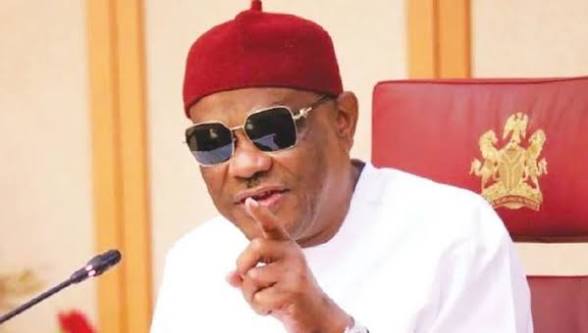
Nigeria’s political atmosphere has once again been stirred by the ever unpredictable movements and statements of the Minister of the Federal Capital Territory, Nyesom Wike. Few political figures in recent Nigerian history command as much attention, controversy, influence, and speculation as the former Rivers State governor. Every meeting he attends, every statement he makes, and every political relationship he maintains often sends shockwaves through both the ruling party and the opposition camp.
This latest political storm erupted after reports surfaced that Wike held a private meeting with the National Chairman of the All Progressives Congress, Nentawe Yilwatda Goshwe, at his residence in Abuja. The development immediately triggered widespread rumors across political circles, social media platforms, and television discussions. Many interpreted the visit as a strong indication that the influential minister was preparing to formally dump the Peoples Democratic Party for the APC.
The speculation intensified because Wike currently occupies one of the most strategic positions in the administration of Bola Ahmed Tinubu despite officially remaining a member of the opposition PDP. For many observers, this unusual political arrangement has long appeared unsustainable. Questions have repeatedly emerged regarding where Wike’s true loyalty lies and whether his continued association with the PDP is merely symbolic.
However, during a public inspection of ongoing infrastructure projects within the Federal Capital Territory, Wike forcefully pushed back against the rumors. Speaking with visible confidence and characteristic bluntness, the minister dismissed claims of a planned defection as baseless political gossip. According to him, his meeting with the APC chairman was nothing more than a friendly visit between longtime associates.
Get TikTok SEO Cheat here
The FCT minister further argued that political disagreements should never destroy personal relationships, insisting that Nigerians have become too obsessed with interpreting every social interaction through a partisan lens. Rather than focusing on political speculation, he maintained that his priority remains governance, project delivery, and fulfilling the mandate entrusted to him by the President.
Yet beneath the public denial lies a deeper political conversation that continues to dominate Nigeria’s power corridors. Wike’s unique political positioning has transformed him into one of the most complex figures in the country’s democratic landscape. To APC loyalists, he is a valuable ally delivering visible results within the federal government. To many PDP stakeholders, however, he remains a disruptive force whose closeness to the ruling party continues to deepen internal divisions within the opposition.
At the same time, the unresolved political tensions in Rivers State continue to cast a long shadow over every move associated with the former governor. The bitter power struggle involving Wike and his successor, Siminalayi Fubara, has fueled endless speculation about possible alliances, strategic calculations, and future political realignments.
For now, Wike appears determined to maintain what many analysts describe as a carefully balanced political identity. He remains deeply connected to the ruling establishment while simultaneously refusing to officially abandon the opposition platform that shaped much of his political rise.
As reactions continue pouring in from supporters, critics, party loyalists, and political observers, one thing remains undeniable. Wike has once again succeeded in placing himself at the very center of Nigeria’s national political conversation.
The Private Meeting That Ignited Nationwide Speculation
The controversy surrounding Wike’s alleged defection plans began shortly after reports emerged that the minister paid a private visit to APC National Chairman, Prof. Nentawe Yilwatda Goshwe, in Abuja.
In Nigeria’s highly charged political environment, meetings involving major political actors rarely go unnoticed. When such meetings occur behind closed doors, speculation often spreads rapidly. In Wike’s case, the political sensitivity surrounding his relationship with the APC made the situation even more explosive.
Political observers immediately interpreted the visit as a strategic move connected to possible future plans within the ruling party. Social media platforms became flooded with claims that Wike was finalizing negotiations to formally join the APC after years of maintaining an unusually close relationship with the governing administration.
Several political commentators pointed to his consistent support for President Tinubu’s government as evidence that an official defection was only a matter of time.
However, Wike strongly rejected these assumptions.
Speaking during an inspection of road projects within the FCT, the minister explained that his relationship with Prof. Goshwe predates current political tensions. According to him, Nigerians must learn to separate personal relationships from partisan politics.
He questioned why political interactions are constantly interpreted as evidence of betrayal or hidden agendas.
“If I visit a friend in another political party, does it automatically mean I want to join that party?” Wike reportedly asked journalists during the briefing.
The minister also revealed that the APC chairman had attempted to visit him several times at the FCTA office. His own visit, according to him, was merely a return gesture rooted in friendship and mutual respect.
Wike’s Direct Response To Defection Rumors
Despite mounting speculation, Wike insisted that he remains focused entirely on governance rather than political maneuvering.
The minister expressed frustration over what he described as endless political distractions designed to shift attention away from developmental projects currently ongoing across Abuja.
According to him, Nigerians should concentrate more on visible governance outcomes instead of political rumors.
He emphasized that his performance should be measured by completed projects, improved infrastructure, enhanced security coordination, and the transformation taking place within the Federal Capital Territory.
Key Statements From Wike
| Political Issue | Wike’s Position |
|---|---|
| Rumored APC Defection | Strongly denied |
| Relationship With APC Chairman | Personal and professional |
| Loyalty To Tinubu Administration | Fully committed |
| PDP Membership Status | Still officially a member |
| Focus As FCT Minister | Governance and infrastructure |
Wike further criticized what he called “roadside political analysis,” arguing that many commentators spend more time discussing political speculation than national development.
His remarks reflected a growing frustration with narratives portraying him as politically unstable or secretly negotiating party movements behind the scenes.
Instead, he projected himself as a leader more interested in practical governance than partisan identity.
Why The Rumors Refuse To Disappear
Although Wike publicly denied plans to defect, political analysts believe the rumors persist because of his highly unusual political position.
It remains extremely rare in Nigerian politics for a senior opposition figure to occupy such a powerful role within a ruling party administration while still retaining official membership in the opposition.
This contradiction continues to generate suspicion across party lines.
Within the PDP, some stakeholders view Wike’s closeness to the APC led government as evidence that he has emotionally and politically detached himself from the party. Several party loyalists have openly accused him of weakening the opposition from within.
Meanwhile, many APC supporters already consider him an unofficial member of the ruling party due to his strong alignment with President Tinubu’s administration.
This political ambiguity has transformed Wike into one of the most discussed political figures in Nigeria.
The Rivers State Crisis Remains A Major Factor
No political conversation involving Wike can be separated from the ongoing power struggle in Rivers State.
The relationship between Wike and Governor Siminalayi Fubara has deteriorated dramatically, resulting in one of the most intense political crises currently unfolding in Nigeria.
The conflict has deeply divided political structures within the state, creating competing loyalties across the Rivers political landscape.
Many analysts believe the continuing tension has influenced speculation surrounding Wike’s relationship with the APC leadership.
Reports surrounding APC activities in Rivers State, including controversies linked to legislative alignments and political screenings, have further intensified suspicions that broader strategic calculations may be unfolding behind the scenes.
Although Wike avoided detailed comments regarding Rivers politics during his briefing, observers believe the crisis remains central to understanding his evolving political posture nationally.
Wike’s Governance Strategy In Abuja
One major reason Wike continues to maintain political relevance despite constant controversy is his aggressive focus on visible infrastructure development.
Since assuming office as FCT Minister, the former governor has consistently highlighted road construction projects, urban renewal efforts, school rehabilitation, sanitation improvements, and security coordination initiatives.
During public appearances, Wike frequently redirects political questions toward governance achievements.
For his supporters, this strategy has proven effective.
Rather than engaging endlessly in partisan disputes, they argue that Wike has positioned himself as a results driven administrator focused on measurable outcomes.
Major Areas Frequently Highlighted By Wike
| Sector | Focus Area |
|---|---|
| Road Infrastructure | Expansion and rehabilitation projects |
| Education | School improvements |
| Urban Development | City sanitation and renewal |
| Security | Coordination within the FCT |
| Public Services | Improved administrative efficiency |
Supporters argue that this governance centered approach allows Wike to maintain relevance across political divides.
Critics, however, insist that infrastructure achievements should not distract from unresolved political controversies surrounding his relationship with both major parties.
The PDP’s Internal Crisis Deepens
Wike’s political stance has continued to expose deep fractures within the PDP.
Several party leaders remain uncomfortable with his open cooperation with the APC led federal government. Some members have repeatedly demanded disciplinary action against him, arguing that his actions undermine opposition unity.
However, Wike still commands enormous influence within the PDP structure due to his longstanding political networks, financial strength, and loyal support base.
This internal division has complicated efforts by the opposition party to present a united front nationally.
Political observers believe Wike’s continued refusal to either fully reconcile with the PDP establishment or officially defect to the APC allows him to maintain maximum strategic leverage.
Political Realism Or Strategic Ambiguity?
Supporters often describe Wike’s approach as political realism.
According to this viewpoint, governance and national development should take precedence over rigid partisan loyalty. They argue that collaboration across party lines should not automatically be viewed as betrayal.
Critics disagree sharply.
To them, Wike’s position represents calculated political ambiguity designed to preserve influence within both political camps simultaneously.
Regardless of interpretation, one reality remains clear. Wike has mastered the art of remaining politically relevant under virtually every circumstance.
His ability to dominate national political discussions while maintaining relationships across rival political structures continues to distinguish him from many contemporary Nigerian politicians.
Public Reactions Across Nigeria
Public reactions to Wike’s comments have remained sharply divided.
Supporters Believe:
| Supporters’ Perspective | Explanation |
|---|---|
| Governance Matters More | Infrastructure delivery should be prioritized |
| Cross Party Relationships Are Normal | Political rivalry should not destroy friendships |
| Wike Is Politically Smart | He understands practical power dynamics |
Critics Believe:
| Critics’ Perspective | Explanation |
|---|---|
| His Actions Create Confusion | PDP membership appears symbolic |
| He Weakens Opposition Unity | Cooperation with APC damages PDP strength |
| Strategic Ambiguity Is Intentional | He benefits politically from uncertainty |
These conflicting reactions further demonstrate Wike’s extraordinary ability to remain at the center of political discourse nationwide.
The Bigger Political Picture
Beyond the immediate rumors, the controversy surrounding Wike reflects larger realities within Nigerian politics.
Party loyalty in Nigeria often shifts around power structures, influence, strategic alliances, and access to governance opportunities. Ideological distinctions between parties frequently become secondary to political survival and influence.
Wike’s situation therefore represents more than a personal political story. It also highlights the fluid nature of political relationships within the country’s democratic system.
His continued balancing act between the APC led federal administration and the PDP opposition structure has become one of the most fascinating political developments in modern Nigerian politics.
Conclusion
By publicly dismissing claims of an imminent APC defection, Nyesom Wike has once again demonstrated his ability to control political narratives while keeping both allies and opponents guessing.
Even as speculation continues, the FCT minister insists that governance remains his overriding priority. Whether Nigerians fully believe that explanation or not, his visible infrastructure push within Abuja has provided him with a powerful shield against political criticism.
Still, the questions surrounding his long term political future remain far from settled.
His close relationship with the APC leadership, his strategic importance within President Tinubu’s administration, and the unresolved political tensions in Rivers State all continue to fuel intense national interest.
For now, Wike appears determined to maintain his current political posture. He remains deeply influential within the corridors of power while refusing to fully commit himself to either side of Nigeria’s increasingly complex political divide.
And in doing so, he continues to embody one of the most intriguing realities of Nigerian politics. Power often speaks louder than party labels.
Read More On: