


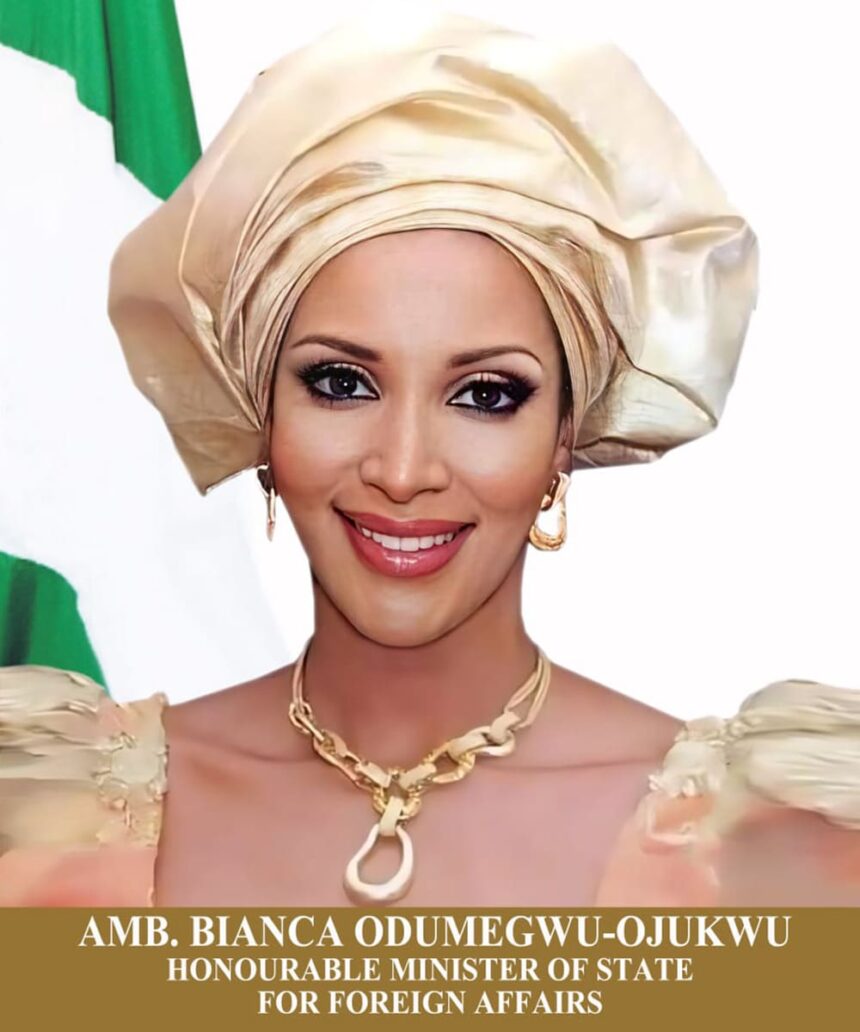

Nigeria’s diplomatic architecture is entering a defining phase as Ambassador Bianca Odumegwu Ojukwu assumes office as the substantive Minister of Foreign Affairs. Her elevation from Minister of State to the nation’s chief diplomatic officer has generated intense political and international attention, not merely because of her public stature, but because of the enormous expectations attached to the office she now occupies.
For many observers, the transition signals far more than a routine cabinet adjustment. It represents a strategic recalibration of Nigeria’s foreign policy priorities at a period when the country is confronting complex international realities that demand stronger diplomatic visibility, economic negotiations, regional peace building, diaspora engagement, and aggressive global repositioning.
Across Africa and beyond, Nigeria remains one of the continent’s most influential powers. With its massive population, strategic economic importance, cultural reach, and leadership role within regional blocs, the country’s diplomatic direction often shapes conversations around security, trade, migration, and democratic governance. The Ministry of Foreign Affairs therefore occupies a highly sensitive position within government operations, serving as the central institution responsible for managing Nigeria’s relationship with the international community.
Ambassador Bianca Ojukwu steps into this responsibility carrying both political symbolism and diplomatic experience. As a former ambassador to Ghana and Spain, and a representative to international organizations, she arrives with a background that combines public diplomacy, cultural engagement, international negotiations, and state representation. Her emergence has therefore triggered renewed discussions about whether Nigeria is preparing to embrace a more visible and citizen focused foreign policy strategy.
Get TikTok SEO Cheat here
Within diplomatic circles, her appointment is also viewed as an attempt to strengthen continuity within the Ministry. Having already served within the foreign affairs structure, she possesses institutional familiarity that could reduce transition delays and accelerate policy execution. This continuity is especially significant at a time when Nigeria is seeking stronger trade alliances, improved international credibility, and more responsive engagement with Nigerians living abroad.
The importance of her appointment extends beyond government corridors. For ordinary Nigerians, especially members of the diaspora community, students abroad, investors, international travelers, and business operators, the effectiveness of the Ministry of Foreign Affairs directly affects issues such as consular protection, visa negotiations, trade facilitation, evacuation during crises, and diplomatic representation.
Her leadership therefore arrives with considerable public expectations.
There is also a symbolic layer to her emergence. As the widow of the late nationalist leader Dim Chukwuemeka Odumegwu Ojukwu, Bianca Ojukwu carries a recognizable political identity that resonates across generations. Yet political analysts argue that her current assignment places greater emphasis on professional competence than symbolism. The Ministry she now leads requires active crisis management, technical negotiations, international lobbying, and sustained bilateral engagement.
Early indications suggest that her administration intends to pursue an assertive diplomacy model centered on national interest, economic partnerships, and citizen protection.
At the center of this evolving strategy is the increasingly discussed “4D Doctrine,” a policy framework designed to redefine Nigeria’s engagement with the world through Democracy, Development, Demography, and Diaspora.
The doctrine is already shaping conversations around the future of Nigerian diplomacy.
Overview of the Leadership Transition
The transition within the Ministry of Foreign Affairs followed significant changes within the federal cabinet structure under President Bola Ahmed Tinubu. The elevation of Bianca Ojukwu from Minister of State to substantive Minister has largely been interpreted as a deliberate effort to preserve policy continuity while injecting renewed momentum into Nigeria’s international engagements.
Political analysts note that continuity within foreign policy institutions is often critical because diplomatic negotiations frequently extend across several years and involve delicate bilateral understandings. Abrupt policy reversals can weaken trust between nations and create uncertainty among investors and development partners.
For this reason, many diplomats welcomed the decision to elevate someone already familiar with the ministry’s operational structure.
Her appointment also reflects the administration’s broader effort to align diplomacy with domestic economic goals. Nigeria’s foreign policy establishment has increasingly moved away from purely ceremonial diplomacy toward more practical engagement focused on investment attraction, security cooperation, technology partnerships, trade facilitation, and diaspora relations.
Within government circles, officials believe Ojukwu’s communication skills and international exposure may help improve Nigeria’s diplomatic branding globally.
The Ministry itself has recently faced growing pressure to become more responsive to emerging international challenges including migration disputes, security cooperation, economic competition, visa restrictions, and the welfare concerns of Nigerians abroad.
Many citizens have repeatedly demanded faster intervention during crises involving Nigerians in foreign countries. Her leadership is therefore expected to prioritize stronger consular responsiveness and faster diplomatic intervention mechanisms.
The Rise of the 4D Foreign Policy Doctrine
Perhaps the most defining element of Minister Bianca Ojukwu’s emerging diplomatic vision is the emphasis on the “4D Doctrine.”
The doctrine serves as a comprehensive framework intended to guide Nigeria’s international engagements across political, economic, demographic, and humanitarian dimensions.
Rather than viewing diplomacy solely through state to state negotiations, the doctrine seeks to position Nigeria’s foreign relations as a direct tool for national transformation and citizen welfare.
Understanding the 4D Framework
| Doctrine Pillar | Strategic Focus | Expected National Impact |
|---|---|---|
| Democracy | Democratic stability and constitutional governance | Regional influence and political credibility |
| Development | Economic diplomacy and foreign investment | Industrial growth and job creation |
| Demography | Youth population and talent export | Global workforce competitiveness |
| Diaspora | Welfare and engagement of Nigerians abroad | Remittances and national integration |
Democracy as a Diplomatic Tool
Under the Democracy pillar, Nigeria aims to strengthen its image as a stabilizing force within West Africa and the broader African continent.
The country has historically played major roles in peacekeeping operations, democratic transitions, and conflict mediation within the ECOWAS region. Minister Ojukwu is expected to deepen these engagements by supporting diplomatic initiatives that encourage constitutional order and political stability.
Diplomatic experts believe this approach could improve Nigeria’s bargaining strength within continental institutions and international organizations.
A stable democratic image also enhances investor confidence, especially among foreign partners seeking predictable governance environments.
Development Through Economic Diplomacy
The Development component of the doctrine reflects a growing shift toward economic centered diplomacy.
Rather than limiting foreign missions to ceremonial functions, Nigerian embassies are increasingly expected to actively pursue investment opportunities, business partnerships, export promotion, and technology transfer initiatives.
Under Ojukwu’s leadership, the Ministry is reportedly intensifying efforts to align foreign policy with national industrial goals.
This means embassies may increasingly function as economic intelligence centers capable of attracting investors and promoting Nigerian business opportunities internationally.
Analysts believe this strategy could significantly benefit sectors such as technology, mining, agriculture, manufacturing, renewable energy, and tourism.
Demography and Nigeria’s Youth Advantage
Nigeria’s population structure remains one of its most powerful geopolitical assets.
With millions of young citizens entering the workforce, the government views demography as a strategic advantage capable of positioning Nigeria as a major global talent supplier.
Minister Ojukwu has emphasized the importance of leveraging this youthful population through international educational partnerships, labor agreements, digital innovation exchanges, and skills mobility programs.
Diplomats argue that countries with strong youthful populations can become influential global workforce contributors if they successfully invest in human capital development.
This dimension of the doctrine therefore connects foreign policy directly to education, technology, entrepreneurship, and migration opportunities.
Diaspora Engagement as National Strategy
The Diaspora pillar may eventually become one of the most publicly visible aspects of the doctrine.
Millions of Nigerians living abroad contribute enormously to the national economy through remittances, investments, professional expertise, and cultural influence. Yet many diaspora communities have repeatedly expressed concerns regarding inadequate diplomatic support during emergencies.
Minister Ojukwu’s administration appears determined to reposition diaspora engagement as a central national priority rather than a peripheral issue.
Officials within the Ministry suggest that Nigerian missions abroad may receive stronger mandates to improve citizen assistance services, legal interventions, evacuation procedures, and diaspora investment coordination.
For Nigerians abroad, this shift could redefine the relationship between citizens and Nigerian embassies globally.
Immediate Diplomatic Test
South Africa Tensions
One of the earliest diplomatic challenges confronting the new Minister involved renewed tensions concerning Nigerians residing in South Africa.
Reports of anti foreigner sentiments and security concerns quickly generated anxiety among Nigerian communities abroad, placing immediate pressure on the Ministry to respond decisively.
Rather than adopting a passive approach, the Ministry reportedly coordinated rapid engagement with South African authorities to strengthen communication channels and improve emergency response coordination.
Creation of Crisis Response Structures
Officials disclosed that discussions focused on establishing direct communication structures capable of responding quickly during emergencies involving Nigerians abroad.
This move reflects the administration’s broader emphasis on proactive diplomacy rather than reactive diplomacy.
The concept of citizen centered diplomacy has increasingly become central to Ojukwu’s public messaging.
According to diplomatic analysts, early crisis responsiveness often determines how seriously a nation’s government is perceived internationally by both citizens and foreign partners.
Citizen Diplomacy and Public Confidence
The handling of the South Africa situation has also become an early test of public confidence in the Ministry’s renewed direction.
Many Nigerians abroad often judge government performance through the responsiveness of embassies during emergencies. Faster intervention, public communication, and visible diplomatic engagement frequently improve trust between citizens and state institutions.
Minister Ojukwu’s insistence that Nigerian citizens abroad deserve dignity and protection appears designed to reinforce this trust.
The New Diplomatic Team and Administrative Structure
To complement the new leadership direction, President Tinubu nominated Ambassador Sola Enikanolaiye as Minister of State for Foreign Affairs.
His emergence adds extensive technical experience to the Ministry’s leadership structure.
Bianca Ojukwu and Sola Enikanolaiye Partnership
Diplomatic observers describe the partnership as a blend of political visibility and institutional expertise.
While Ojukwu provides symbolic leadership, international representation, and strategic communication, Enikanolaiye contributes decades of diplomatic and administrative experience accumulated through various international postings.
This combination is expected to strengthen policy execution and improve coordination across diplomatic missions.
Key Diplomatic Experience Comparison
| Official | Primary Strength | Diplomatic Background |
|---|---|---|
| Bianca Ojukwu | Public diplomacy and political engagement | Spain, Ghana, international representation |
| Sola Enikanolaiye | Technical diplomacy and negotiations | London, Ottawa, New Delhi |
| Combined Goal | Faster policy implementation | Stronger institutional coordination |
Economic Diplomacy and International Partnerships
One of the clearest expectations surrounding the new administration is the aggressive pursuit of economic diplomacy.
Global diplomacy today increasingly revolves around trade, investment competition, energy security, technology partnerships, and industrial cooperation.
Nigeria’s leadership appears determined to ensure that diplomatic missions contribute directly to economic development objectives.
Strengthening Bilateral Relations
Recent diplomatic engagements involving countries such as Italy and Austria indicate renewed focus on security cooperation, trade expansion, and counter terrorism collaboration.
Security diplomacy remains particularly important because regional instability continues to affect investment confidence and economic growth across parts of Africa.
Through bilateral partnerships, the Ministry aims to strengthen intelligence cooperation, economic exchanges, and technical partnerships.
Investment Promotion Strategy
Sources within diplomatic circles indicate that preparations are underway for major international investment engagements designed to market Nigeria as a prime destination for African business expansion.
Key sectors expected to dominate these engagements include technology, agriculture, mining, infrastructure, renewable energy, and digital innovation.
Officials believe stronger diplomatic engagement with global investors could improve Nigeria’s competitiveness within emerging markets.
Bianca Ojukwu’s Legacy, Identity, and Leadership Style
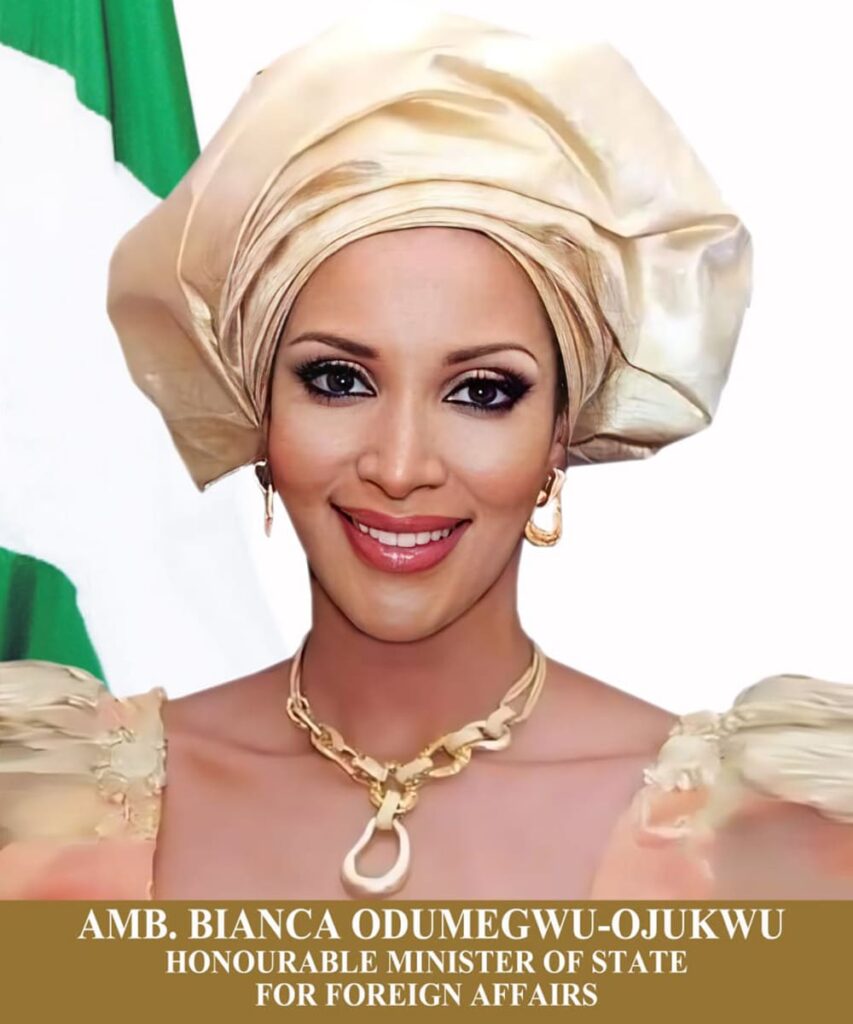
Public attention surrounding Bianca Ojukwu extends beyond diplomacy because of her unique personal and political background.
As the widow of Dim Chukwuemeka Odumegwu Ojukwu, she occupies a recognizable place within Nigeria’s political history. However, observers increasingly argue that her diplomatic career has gradually established an independent professional identity separate from historical associations.
Her background in international representation, cultural diplomacy, and public communication has contributed to her visibility both within Nigeria and abroad.
Soft Power and International Representation
Diplomatic experts often emphasize the importance of “soft power” in modern foreign policy.
Soft power refers to a country’s ability to influence global perception through culture, communication, values, education, and international image.
Bianca Ojukwu’s public profile and communication style may therefore become strategic assets for Nigeria’s international branding efforts.
Her ability to combine diplomacy with cultural representation could strengthen Nigeria’s visibility within global forums.
Leadership Profile
Minister Bianca Ojukwu
| Category | Details |
|---|---|
| Current Position | Minister of Foreign Affairs |
| Former Position | Minister of State for Foreign Affairs |
| Foreign Policy Framework | 4D Doctrine |
| Diplomatic Philosophy | Citizen Centered Diplomacy |
| Major Diplomatic Focus | Economic partnerships and diaspora welfare |
| Notable International Experience | Spain, Ghana, international tourism representation |
Implications for Nigerians at Home and Abroad
For ordinary Nigerians, the implications of this leadership transition may eventually become visible through practical diplomatic reforms.
Travelers may experience stronger embassy responsiveness.
Business owners could benefit from expanded trade promotion initiatives.
Students abroad may receive faster diplomatic support during emergencies.
Diaspora communities may experience improved engagement with Nigerian missions overseas.
Investors and foreign partners may also watch closely to determine whether the Ministry successfully translates diplomatic rhetoric into measurable outcomes.
Ultimately, the effectiveness of the new administration will likely be judged not merely by speeches or symbolic appointments, but by tangible diplomatic results.
Conclusion
Ambassador Bianca Odumegwu Ojukwu’s emergence as Nigeria’s substantive Minister of Foreign Affairs marks a defining development within the country’s diplomatic evolution.
Her administration begins at a period when Nigeria faces growing expectations both domestically and internationally. From economic diplomacy and diaspora engagement to regional stability and global partnerships, the Ministry now stands at the center of several national priorities.
The emphasis on the 4D Doctrine suggests an attempt to modernize Nigeria’s foreign policy framework and align diplomacy more directly with citizen welfare and economic transformation.
Whether through crisis intervention, investment promotion, or citizen centered diplomacy, the coming months are expected to reveal how effectively this new leadership translates diplomatic vision into practical outcomes.
For Nigeria, the transition represents more than a change in office holders.
It represents an important test of how diplomacy can be transformed into a direct instrument of national development, international influence, and citizen protection.
Read More On: