For more than two decades, search marketing has operated on a relatively simple idea: Someone searches. Google shows results. A business competes to appear at the top.
That model created an enormous industry around keywords, SEO, Google Ads, landing pages, backlinks, search rankings and conversion optimisation.
But something fundamental is changing. People are no longer only searching for information.
They are asking AI to think with them.
Instead of typing:
“Best MBA programmes in Lagos”
a potential student can ask:
“I work in finance, I have seven years of experience, and I want an MBA in Lagos that will help me move into senior management. Compare my best options based on cost, reputation, flexibility and career value.”
That is not simply a search query.
It is a decision-making conversation.
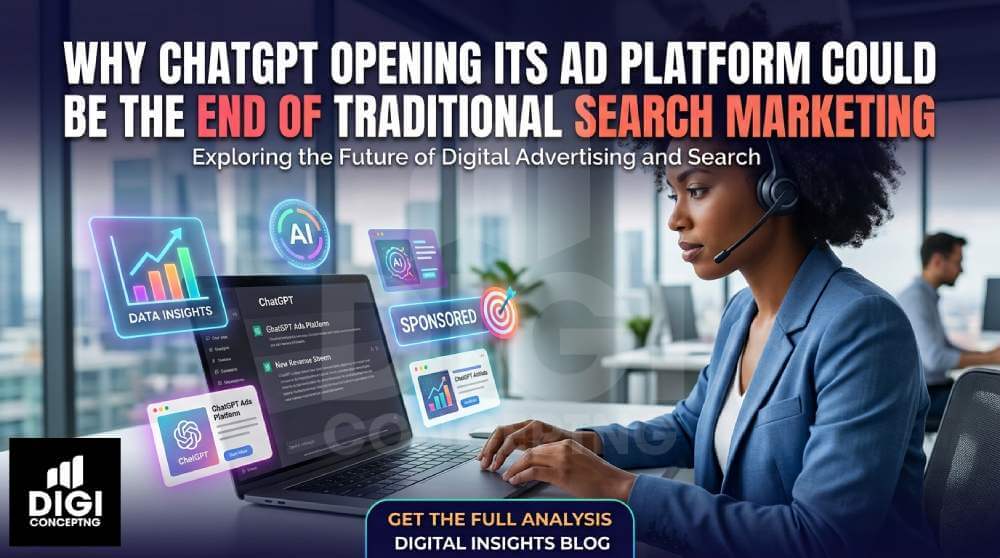
And this is where ChatGPT’s advertising platform becomes much more interesting than another competitor to Google Ads.
The real threat to traditional search marketing isn’t that ChatGPT has ads.
It is that ChatGPT is changing what the word “search” means.
Read more on ChatGPT Ads Are Now Open to Everyone: What Businesses, Marketers and Users Need to Know
Search Used to Start With a Keyword. Now It Can Start With a Conversation.
Google built an incredible advertising business around intent expressed through keywords.
If someone searches:
“Buy running shoes”
the advertiser can reasonably assume that person has commercial intent.
The marketer bids on the keyword, writes an ad, sends the user to a landing page and tries to convert them.
It works because the keyword provides a useful signal.
But conversational AI can collect something much richer than a keyword.
A user might tell ChatGPT:
“I’m training for my first half marathon. I have flat feet, my budget is around ₦150,000 and I usually run on roads. Which shoes should I consider?”
Now the platform has context.
It knows the activity.
The experience level.
The potential problem.
The budget.
The environment.
And, importantly, what the person is trying to accomplish.
OpenAI’s own advertising materials highlight this difference, describing ChatGPT Ads as an environment where people explore options, compare alternatives and make decisions. Its advertising system uses conversational context rather than relying only on simple keyword matching.
That is a major shift in advertising.
Google asks:
“What did you search?”
AI can ask:
“What are you trying to achieve?”
That distinction could reshape performance marketing.
The Search Results Page Is No Longer the Destination
Traditional search marketing is heavily dependent on the search results page.
The marketer’s objective is straightforward:
Get visibility → get the click → get the visitor → convert the visitor.
But AI search can compress those steps.
A user can ask a question, receive an explanation, compare alternatives and decide what to do without opening ten different websites.
That changes the value of the click.
Imagine someone asks:
“What are the best business schools in Nigeria for an executive MBA?”
Traditionally, several institutions would compete for:
- SEO rankings
- Google Ads positions
- Featured snippets
- Reviews
- backlinks
- branded searches
But an AI interface could potentially become the first layer of comparison.
The user may ask a follow-up:
“Which one is best if I work full-time?”
Then:
“Which has an international qualification?”
Then:
“Which is closest to what I want to do?”
The platform isn’t simply displaying advertisements around the research process.
It is sitting inside the research process.
That is the strategic difference.
ChatGPT Ads Are Not Just Another Ad Placement
It would be easy for marketers to look at ChatGPT Ads and think:
“Great. Another platform where I can buy impressions.”
That would be a mistake.
OpenAI’s current advertising model places ads separately from ChatGPT’s answers and clearly labels them as advertisements. OpenAI also says ads do not influence the answers themselves.
The interesting part is not necessarily the visual ad unit.
It is where the ad appears.
Consider the difference between these two situations.
Traditional display advertising
Someone is reading an article about starting a business.
An advertisement for accounting software appears beside the article.
The advertiser hopes the person is interested.
Conversational advertising
Someone tells ChatGPT:
“I’m starting a small business and need accounting software that can handle invoices and Nigerian tax requirements.”
That is a completely different advertising environment.
The second person has effectively raised their hand.
They are telling the platform what problem they are trying to solve.
For marketers, that potentially makes the advertising opportunity much more valuable.
The Biggest Change: Keywords May Become Less Important
This does not mean keywords will disappear. Search queries will still matter. But marketers may have to think beyond keyword lists.
For years, SEO professionals have asked:
“What keywords should we rank for?”
The better question in an AI-first search environment may become:
“What questions should our brand be the best answer for?”
That sounds like a small change.
It isn’t.
Imagine a university.
Its traditional SEO strategy might target:
- MBA Nigeria
- MBA Lagos
- Executive MBA Nigeria
- Masters programmes Lagos
- Business school Nigeria
Those keywords still matter.
But an AI-first strategy would also consider questions such as:
- Which MBA is best for someone working full-time?
- What should a Nigerian professional consider before choosing an MBA?
- Is an MBA worth it after 10 years of work experience?
- What business programmes are suitable for someone moving into management?
- What is the difference between an MBA and an Executive MBA?
- Which business school programmes have an international orientation?
The competition moves from ranking for words to being useful in decisions.
SEO Is Not Dead. But “Ranking” Is No Longer the Whole Game.
This is where marketers need to be careful.
There has been a lot of noise around “SEO is dead.”
It isn’t.
Google still processes enormous amounts of search activity, and websites remain essential sources of information, authority and conversions.
But SEO is becoming broader.
Google itself is increasingly integrating AI-generated experiences into search. Recent changes have even pushed traditional search links further down the page as AI Overviews become more prominent.
So the future isn’t necessarily:
SEO → dead
It is:
SEO → evolves
The marketer now has to think about at least three layers:
1. Search Engine Optimisation
Can Google discover, understand and rank your content?
2. Answer Engine Optimisation
Can AI systems understand your brand and confidently use your information when answering questions?
3. Conversion Optimisation
Once someone discovers you, can your website turn that interest into an enquiry, application, purchase or booking?
The winning brands will connect all three.
Welcome to the Age of “Answer Visibility”
For years, marketers obsessed over:
Search visibility.
How often does my website appear when someone searches for something?
Now another question is emerging:
Answer visibility.
When someone asks an AI system about my category, product, service or problem, does my brand become part of the answer?
This is a fundamentally different measurement problem.
A company might rank #1 for an important keyword and still be poorly represented in an AI-generated recommendation.
Conversely, a company may not dominate traditional search rankings but could become highly visible when AI systems discuss a particular category because its content is clear, authoritative and easy to understand.
Early research into generative search is already showing that commercial recommendations can vary depending on factors such as query language and location.
That should make marketers pay attention to something they often overlook:
Context.
Your Website Now Has Two Audiences
This is another major shift.
Your website has always been built for humans.
Now it increasingly needs to be understandable to machines.
Not because robots are your customers.
Because AI systems may act as intermediaries between your content and your customers.
That makes things like these more important:
- Clear website architecture
- Strong internal linking
- Structured data
- Authoritative content
- Accurate business information
- Clear product/service descriptions
- Fast-loading pages
- Crawlable content
- Consistent brand information
- Strong third-party references
- Frequently updated information
Website performance is also becoming increasingly relevant to AI discoverability because slow or technically difficult websites can make it harder for systems to access and interpret information.
In other words:
Technical SEO isn’t becoming less important.
It may actually become more important.
The New Competition Won’t Just Be for Clicks
This is perhaps the biggest lesson for performance marketers.
Google Ads largely creates competition for:
Clicks.
AI advertising could increasingly create competition for:
Recommendations, consideration and decisions.
Think about the customer journey.
Traditional:
Search → Ad → Website → Research → Decision
AI-assisted:
Question → Conversation → Comparison → Recommendation → Decision
The second journey potentially removes several steps.
And whoever influences the conversation early could have an enormous advantage.
This Could Completely Change Landing Pages
Here’s another uncomfortable question for marketers:
What happens when the first interaction with your brand isn’t your website?
Historically, we have optimised landing pages around:
- headlines
- CTAs
- forms
- testimonials
- benefits
- pricing
- social proof
All of these remain important.
But brands may increasingly need to create information ecosystems that AI systems can understand.
For example, instead of publishing one generic page saying:
“Why Choose Us?”
a company could build a comprehensive knowledge base answering the actual questions customers ask.
For a business school, that could include:
- MBA vs Executive MBA
- MBA cost in Nigeria
- Who should study an MBA?
- MBA career opportunities
- MBA for entrepreneurs
- MBA for working professionals
- How to choose a business school
- International accreditation explained
- What to expect from an MBA programme
- Career outcomes after an MBA
This content doesn’t just chase traffic.
It builds decision authority.
Advertising Will Become More Contextual
Traditional digital advertising often relies on audiences.
For example:
Women, 25–34, Lagos, interested in fashion.
Or:
Business owners in Nigeria.
AI advertising can potentially move much closer to intent + context.
The user may literally explain the problem.
That could eventually make advertising less about:
“Find the right audience.”
and more about:
“Find the right moment.”
That’s powerful.
A person researching wedding venues is different from someone casually reading about weddings.
A person asking about MBA options is different from someone watching a business video.
A person saying:
“I need to replace my laptop this month and I have ₦800,000 to spend”
is sending a very different commercial signal from someone who simply searched:
“best laptops.”
The future of advertising could therefore become increasingly problem-aware rather than demographic-first.
But There Is a Big Catch
AI advertising also creates serious challenges.
The first is trust.
If people believe AI recommendations are being manipulated by advertisers, the value of the platform could deteriorate quickly.
That’s why OpenAI currently emphasises that its ads are clearly identified and separate from ChatGPT’s responses.
The second challenge is measurement.
Google Ads gives marketers familiar metrics:
- impressions
- clicks
- CPC
- conversions
- conversion rate
- ROAS
But how do you measure the value of being mentioned during a conversation?
What happens when a person sees your brand, doesn’t click, continues talking to ChatGPT, then searches for your company two days later?
Attribution becomes much harder.
And this means marketing dashboards will eventually need to move beyond:
“How many clicks did we get?”
towards:
“How many decisions did we influence?”
The First-Mover Advantage Could Be Huge
OpenAI says tens of thousands of advertisers are already using ChatGPT Ads, and the platform has expanded internationally. Its advertising business reached a $1 billion annualised revenue run rate in August 2026, less than 200 days after launch.
Those numbers matter.
Not because ChatGPT has suddenly replaced Google.
It hasn’t.
Google remains an advertising giant.
But they show something else:
Advertisers are willing to follow users into new search environments.
And when behaviour changes, advertising budgets eventually follow.
We saw this with:
- desktop → mobile
- websites → social media
- organic reach → paid social
- text → video
- search → discovery
Now we are moving from:
search engines → answer engines
And marketers who wait until the transition is obvious may already be late.
What Should Marketers Do Now?
Don’t abandon Google Ads.
Don’t stop doing SEO.
Don’t suddenly move your entire marketing budget to ChatGPT.
Instead, start experimenting.
1. Build a “question map”
List the questions your customers ask before buying.
Not just keywords.
Actual questions.
Then create genuinely useful answers.
2. Strengthen your website’s authority
Make sure your website clearly communicates:
- who you are
- what you offer
- who you serve
- where you operate
- why people should trust you
- evidence of your expertise
3. Create content for decisions, not just traffic
Instead of asking:
“What article can get 5,000 visits?”
ask:
“What information would help someone choose us?”
That produces much stronger content.
4. Start testing AI advertising
If ChatGPT Ads are available in your target market, treat them as an experimental channel.
Don’t copy your Google Ads campaigns blindly.
The advertising environment is different.
OpenAI itself recommends multiple distinct ad variations and benefit-focused messaging rather than simply recycling generic advertising copy.
5. Track brand demand
Monitor:
- branded searches
- direct traffic
- referral traffic
- AI referral sources where available
- enquiries
- assisted conversions
- branded mentions
- conversion quality
AI may influence a customer without producing an immediate click.
6. Think beyond Google
Your customer doesn’t care which search engine you optimise for.
They care about getting the right answer.
Your job is to make sure your brand is findable wherever decisions are being made.
So, Is This Really the End of Traditional Search Marketing?
Not exactly.
And this distinction matters.
Google isn’t disappearing.
SEO isn’t disappearing.
Keywords aren’t disappearing.
Search advertising isn’t disappearing.
What’s disappearing is the assumption that search marketing begins and ends with a search-results page.
That is the real change.
The next generation of digital marketing will probably combine:
SEO + paid search + social + AI visibility + conversational advertising + strong first-party data + brand authority.
The smartest marketers won’t ask:
“Should we choose Google or ChatGPT?”
They’ll ask:
“Where is our customer asking questions, comparing options and making decisions?”
Then they will build a presence there.
The Real Battle Is for the Customer’s Consideration Set
This is ultimately what makes AI advertising so interesting. Advertising has always been about getting attention. Search marketing improved that by capturing intent.
AI could take it one step further by capturing contextual intent.
And that changes the game.
Because when someone asks an AI:
“What should I choose?”
they aren’t just looking for information anymore.
They are narrowing down their options.
They are creating a shortlist.
They are making a decision.
And if your brand isn’t part of that shortlist, ranking #1 for a few keywords may not be enough.
The future of search marketing may therefore not be about owning the top position.
It may be about earning a place in the answer.
And that is a much bigger shift than simply putting ads inside ChatGPT.
Final Thought
For marketers, this is the moment to stop thinking of AI as just another content-generation tool.
It is becoming a new layer of the customer journey.
Google taught businesses to optimise for searches.
Social media taught them to optimise for attention.
AI is now forcing them to optimise for conversations, context and decisions.
The brands that understand this early will not necessarily be the ones with the biggest advertising budgets.
They will be the ones that consistently provide the clearest answers, demonstrate real authority and make themselves useful at the exact moment a customer is trying to decide.
The search engine isn’t necessarily dying.
The search box is simply becoming a conversation.